
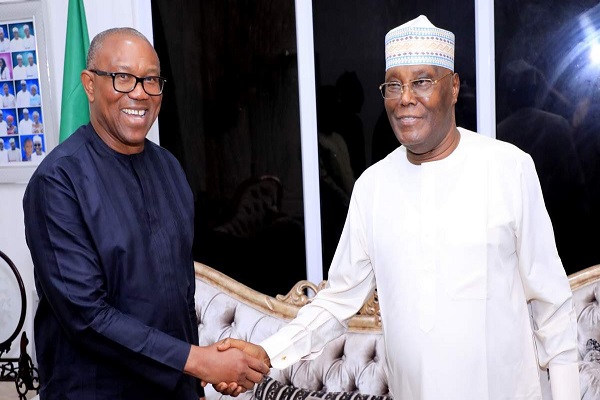
Peter Obi, presidential candidate of the Nigeria Democratic Congress, has ruled out stepping down for African Democratic Congress candidate Atiku Abubakar ahead of the 2027 presidential election.
Obi said any decision on a possible opposition alliance should now be negotiated by the political parties rather than treated as a personal arrangement between him and Atiku.
Speaking during an interview with Arise Television on Thursday, the former Anambra State governor said both politicians were now presidential candidates of different parties.
“Where we are now is that I’m a candidate, my leader Atiku is a candidate of another party,” Obi said.
He explained that any merger or alliance would require discussions between the parties on how their different political structures and candidates would be brought together.
The comments come amid renewed efforts by opposition politicians to form a common platform capable of challenging President Bola Tinubu and the ruling All Progressives Congress in the 2027 election.
Obi and Atiku were part of an opposition coalition in 2025 that adopted the ADC as its platform. However, the coalition did not result in both politicians contesting the 2027 presidential election on the same platform.
Obi later emerged as the NDC presidential candidate, while Atiku became the ADC candidate.
Asked whether he would accept the vice-presidential position if an agreement was eventually reached with Atiku, Obi denied claims that he had previously rejected an offer to become Atiku’s running mate.
“I don’t know where that was said. I wasn’t even in a position where that was being offered, and I refused,” he said.
Obi previously served as Atiku’s running mate under the Peoples Democratic Party in the 2019 presidential election. Their political paths diverged ahead of the 2023 election, when Obi left the PDP to contest under the Labour Party while Atiku remained the PDP presidential candidate.
Obi backs naira float, calls for higher productivity
The NDC candidate also said he would retain the floating exchange-rate policy introduced by the Tinubu administration if elected president.
“There’s one, the floating of the Naira. I’m not going to defend it. But I’m going to put productivity to make it more valuable to the people,” he said.
Obi argued that Nigeria needed to move away from a consumption-driven economy and increase production, agriculture, exports and investment to strengthen the naira.
Obi rejects tribal politics
On national politics, Obi urged Nigerians not to allow ethnicity to determine their choice of presidential candidate in 2027.
“Our election should not be driven by tribalism,” he said.
He also sought to reassure Nigerians in the North, saying he remained committed to the region’s development and believed agriculture could provide significant economic opportunities.
Addressing attempts to link him to the 1966 military coup, Obi said he was only four years old when the event occurred.
“There were regrettable things that happened in our collective history. I was not personally involved in those sad events, but it is time to show love and pursue unity in Nigeria,” he said.
Obi wants presidential holidays spent in Nigeria
Obi also criticised Nigerian presidents who spend their holidays abroad, saying the President should remain in the country and use vacation periods to visit areas facing security and development challenges.
He said that, if elected, he would ensure presidential holidays were spent in Nigeria, including visits to states such as Zamfara, Borno and Anambra.
Obi further argued that presidential visits to troubled states should go beyond brief official engagements.
He said a president should spend several days in affected states, meeting residents, traditional rulers, government officials and other stakeholders to gain a deeper understanding of their challenges.