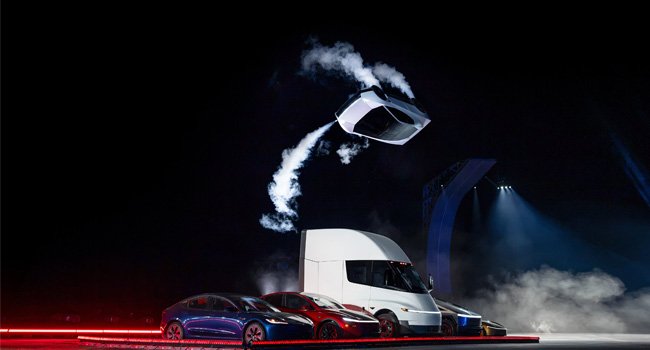
Tesla chief executive Elon Musk has unveiled a new Roadster sports car equipped with thrusters, describing the demonstration as a step towards making flying cars a reality.
The vehicle was showcased during a livestreamed event at a SpaceX test facility in Texas on Thursday, with the demonstration broadcast on Tesla’s X account.
During the presentation, the car launched from a steep ramp before landing on its wheels, prompting Musk to declare, “Flying cars are real.”
However, the billionaire acknowledged uncertainty surrounding the technology, saying the vehicle’s “success is not guaranteed” but that “it will probably work”.
Musk said the car was fitted with ultra-high-pressure air tanks designed to propel it into the air, although the demonstration described in the presentation did not establish that it could sustain flight.
He attributed the development to collaboration between Tesla, the electric vehicle manufacturer, and SpaceX, his rocket company.
“What happens when you have a collaboration with the world’s best car company and the world’s best rocket company,” Musk said, describing the project.
According to Musk, the vehicle is expected to enter production in 2028. However, technical and regulatory hurdles remain significant challenges for the wider flying-car industry.
Flying Cars Face Technical Challenges
The concept of flying cars has existed for more than a century. American aviation pioneer Glenn Curtiss unveiled an early flying-car prototype in 1917.
Despite decades of experimentation, practical flying cars have yet to achieve widespread commercial adoption.
Recent advances in electric motors and high-performance batteries have renewed interest in the sector, with developers exploring vehicles that combine road transport with aviation capabilities.
However, such vehicles face challenges involving safety, engineering, airspace regulation and commercial viability.
Musk’s announcement places Tesla’s latest Roadster concept within this evolving industry, although its planned 2028 production timeline will depend on the project’s technical progress and the requirements for bringing the vehicle to market.