
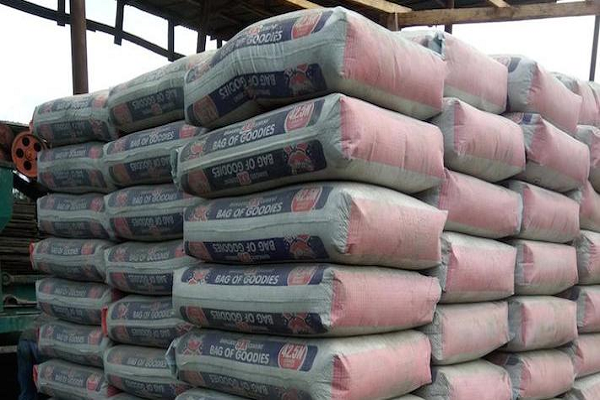
A bag of cement cannot be sold below N7,000 due to the increasing cost of production, manufacturers said yesterday.
They said the rise in operating costs was responsible for the price hike.
The producers have agreed to reduce the price per 50kg bag from between N9,000 to N15,000 to between N7,000 and N8,000 depending on the location nationwide.
Representatives of Dangote Cement Plc, BUA Cement Plc and Lafarge Africa Plc made the commitment after a meeting with Minister of Works, David Umahi, which was attended by his Industry, Trade and Investment counterpart, Doris Uzoka-Anite in Abuja.
Umahi called the meeting following the skyrocketing price of cement.
The manufacturers blamed the high cost of gas, import duties, bad road network, smuggling and the prevailing foreign exchange rate for the hike.
Executive Director of BUA, Kabir Rabiu, said the manufacturers would abide by the agreement.
He said: “Our cost component of energy went from 39 per cent to 60 per cent.
“The price of gas last year was N415, then it went to N715.
“Today, we are paying over N1,500. All these issues were discussed and we gave our commitment.
“When our six million tonnes of cement is supplied to the market in a few weeks, definitely we will see a sharp drop in prices when that volume hits the market.”
He said the huge disparity between demand and supply also played a major role in the price increase.
According to him, some manufacturing plants could not produce for some reason, which led to a reduction in production.
“Being the highest period of cement demand in the country, the tendency that demand will outstrip supply will push the price up,” he said.
He also said cross-border smuggling contributes to the scarcity of the commodity.
According to him, a bag of cement costs far more in Cameroun, which makes it attractive to move the product there illegally.
Read Also:
Police recover stolen cement truck in Anambra, hijackers on the run
Group Managing Director/Chief Executive Officer of Dangote Cement Plc, Arvind Pathak, said notwithstanding that the core materials are locally sourced, spare parts and other variables are subject to import duties and foreign exchange.
A communique issued after the meeting, read by Umahi, states: “We discussed extensively the current prices of Cement viz a viz the challenges of the manufacturers.
“The manufacturers talked about their challenges ranging from the high cost of gas, import duties, bad road network and of course the high rate of FX against the naira.
“We also talked about the smuggling of cement across the borders.
“The government noted the challenges and we agreed that the Minister of Industry, Trade and Investment will seek some remedies from the President on the high cost of gas, issue of import duties and fixing of the roads, especially within the distribution corridors.
“On the issue of smuggling, the Trade Minister will brief the National Security Adviser (NSA) on smuggling the commodity across the borders.
“The government and the manufacturers noted that depending on the location, ideally, the price should not be more than N7,000 and N8,000 per 50 kg bag of cement.
“Therefore, the manufacturers – BUA Cement Plc, Dangote Cement Plc and Lafarge Africa Plc have agreed to sell their cement at between N7,000 and N8,000 per 50kg depending on the location.
“The Federal government and cement manufacturers will set up a price monitoring mechanism to ensure compliance.
“The manufacturers have accepted to sanction, on their own, any of their distributors or retailers found wanting.
“The government expects the agreed price to drop after securing government’s interventions on the challenges of the manufacturers on gas, import duty, smuggling, and better road network.
“It was also agreed that the government will encourage the emergence of at least six cement manufacturers to augment the three existing companies.
“We also agreed to reconvene in 30 days to review progress.”
Uzoka-Anite said the government was working hard to ensure that the prices of all commodities were reduced.