

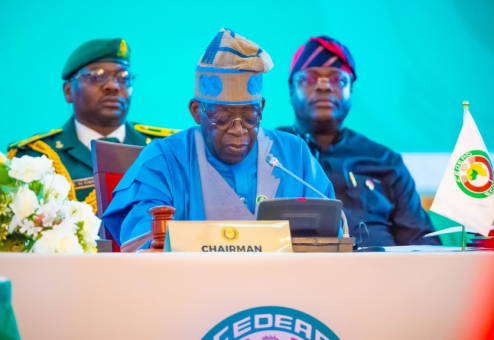
Another chapter opened yesterday in the history of the Economic Community of West African States (ECOWAS) with the re-election of President Bola Ahmed Tinubu as chairman of Heads of State and Government.
He was first elected in Guinea-Bissau on July 9 last year after just one month and a few days as Nigeria’s president.
President Tinubu immediately picked the gauntlet, promising to deepen democracy in the sub-region and push on for the formation of a standby force to enhance security in West Africa.
The unity of the 16-member body, which was threatened following the coup d’état in three member states, took a new turn.
Mali, Burkina Faso and Niger Republic, ruled by military juntas, formed the Alliance of Sahel States (AES) at the weekend.
Read Also: Hijack of PMS truck: Police confirm suspects as ex-officers
The African Union (AU) rejected the move.
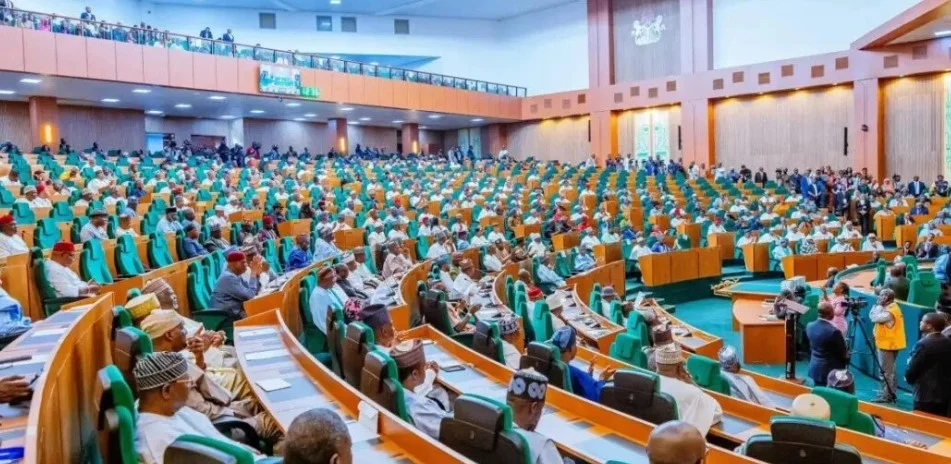
The sub-regional body after yesterday’s 65th Ordinary Session meeting held at the State House Conference Centre, Abuja, set up a team to hold talks with them.
The ECOWAS chairman said: “I have appointed the President of Senegal, Bassirou Diomaye Faye, to please, become our Special Envoy to Burkina Faso, Mali, and Niger Republic, along with the President of Togo, Faure Gnassingbé, to do round the clock work with our brothers in Mali, Burkina Faso, and Niger Republic, and to coordinate with me and the ECOWAS Commission, where necessary.
“I have accepted to continue the service to the great members and the great minds that are committed to democratic values and our journey in the region.
“I will continue to serve our interest and build on democratic values and the structure that we inherited.”
President Tinubu urged the Heads of State and Government of ECOWAS to work towards the establishment and sustenance of a regional standby force for the security and economic advancement of the community.
He emphasised the expediency of a standby force in the face of growing security threats in the region.
‘Redeem financial obligations’
President Tinubu urged member-states to fulfil their financial commitments so that the regional body could effectively tackle security challenges.
He said substantial financial resources are crucial to the take-off of the ECOWAS Standby Force (ESF) to combat terrorism, banditry and violent extremism.
He said if member states honour their financial obligations, it would enable ECOWAS to meet the expectations and recommendations of its ministers of defence on regional security.
He said: “Let me underscore that a peaceful and secure society is essential for achieving our potential.”
He said the move to operationalise the ECOWAS Standby Force (ESF) was key to combating terrorism.
President Tinubu added: “I must emphasise that the success of this plan requires, not only strong political will but also substantial financial resources.
“We must, therefore, ensure that we meet the expectations and recommendations set forth by our ministers of Defence and Finance in order to counter the insecurity and stabilise our region.
“Member states must make extra commitment to providing resources for stabilising the region.
“To this end, I urge ECOWAS to leverage the capability of the Nigeria National Counter Terrorism Center (NCTC), which is widely acknowledged as one of the best on the continent.
“The Nigerian government has decided to declare the NCTC as a regional centre to enable all ECOWAS member states to benefit from capacity building and other related opportunities it offers.
“Your Excellencies, dear heads of state, I urge you to visit the centre before your departure and assess first-hand the facilities and the capabilities of NCTC.”
President Tinubu also urged ECOWAS member states to unite and develop innovative approaches to unlock the region’s economic potential and promote prosperity.
He acknowledged the economic hurdles hindering progress and stressed the need for partnerships, investment, and infrastructure development.
President Tinubu emphasised the importance of a conducive business environment to stimulate growth and build resilience against external aggression.
He urged member states to comply with the protocol on community levies to ensure adequate resources for the organisation’s programmes, assuring of Nigeria’s commitment not to default on its finance commitments.
President Tinubu added: “I’m also fully aware of other challenges confronting our region, especially the economic hurdles that hinder our progress to elevate our people from poverty to prosperity.
“It is imperative that we unite as a community and develop innovative approaches to unleash our vast economic potential.
“We must continue to identify and develop partnerships that promote investment in key sectors and promote regional trade.
“Furthermore, we must invest in our infrastructure and cultivate a conducive business environment to empower our community to stimulate growth and build resilience against external shock.
“Together, we can pave the way for a prosperous future for all ECOWAS countries.”
President of the ECOWAS Commission, Dr. Omar Alieu Touray, said the region had proved that democracy is alive because of the successful transition in Senegal, Nigeria, Guinea Bissau, Sierra Leone and Liberia.
He said: “We look forward to the consolidation of this trend in the region as we prepare for a major election in Ghana later this year.”
Touray warned that the region was still being confronted with multidimensional challenges, which seem to overshadow its modest achievements
He said: “Our region is still confronted with multiple interlocking threats, including existential works.
“These include climatic and man-made crises, leading to terrorism and violent extremism and food insecurity.
“Livelihoods continued to be threatened by illegal and unsustainable exploitation of our land, forest and marine resources.
READ ALSO:
Tinubu replace old withholding tax policy with new one
“Governance deficit and marginalisation have strained social contracts, engendering bitter rivalries and unhealthy competition.
“To complicate the situation, our region has become the arena of geo-strategic and geo-political rivalries and the theatre of misinformation and disinformation that engenders mistrust among and within communities and undermine social cohesion.”
Touray said the Commission had commenced preparation for the 50th anniversary of the regional body.
The Commission would propose a Special Extra-ordinary Summit on the future of the Community, he added.
AU seat: Tinubu seeks ECOWAS’ support for re-election
President Tinubu solicited the support of member states to retain the position of AU Commissioner for Political Affairs and Security.
The President reminded them that the AU election will be held on February 25, next year.
The Nigerian seat at the AU Commission is currently occupied by Ambassador Bankole Adeoye.
President Tinubu said: “Our region continues to face significant security challenges, including terrorism, violence extremism and banditry.
“Currently West Africa holds the position of AU Commissioner for political affairs and security, a crucial role for our region.
“Therefore, I solicit our support for the candidacy of Ambassador Bankole Adeoye seeking re-election as the sole male candidate for this position for our region.”
AU: withdrawal not acceptable
The AU said the purported withdrawal of Burkina Faso, Mali and Niger from ECOWAS is not acceptable.
AU said it believed in the unity of ECOWAS, adding that it would support efforts to ensure the region’s prosperity.
Moussa Faki, Chairperson of AU Commission, commended the efforts of ECOWAS in addressing insecurity in the region.
Faki, who was represented by Ambassador Adeoye, also described ECOWAS as a pace-setter in security and constitutional transition of government as exemplified in the recent elections in the region.
He said: “African Union is very proud of ECOWAS. We advocate and fully support the unity of ECOWAS. The withdrawal of the three countries is not acceptable to the African Union.”
Three countries form Union of Sahel
Military rulers in Mali, Burkina Faso and Niger converged on the Nigerien capital of Niamey at the weekend to form a confederation of three Sahel states.
At their first summit since taking power in military coups, Mali, Niger and Burkina Faso leaders adopted a joint statement for a treaty to set up the confederation.
“This summit marks a decisive step for the future of our common space.
“Together, we will consolidate the foundations of our true independence, a guarantee of true peace and sustainable development through the creation of the ‘Alliance of Sahel States’ Confederation’,” Capt. Ibrahim Traore, the leader of Burkina Faso, wrote on his X handle.
He added: “The AES (Alliance of Sahel States) is full of enormous natural potential which, if properly exploited, will guarantee a better future for the people of Niger, Mali and Burkina Faso.”
Ties between the three Sahel nations and ECOWAS had deteriorated after Gen. Abdourahamane Tiani took power from elected President Mohamed Bazoum in a coup in Niger in July.
ECOWAS imposed sanctions on Niger and threatened intervention which irritated the trio.
The three countries, with a combined population of 72 million, are affected by instability caused by militant groups.
The trio is expected to cooperate on security issues and form closer economic ties.


https://t.me/s/flagman_official_registration
https://t.me/s/be_1win/981