

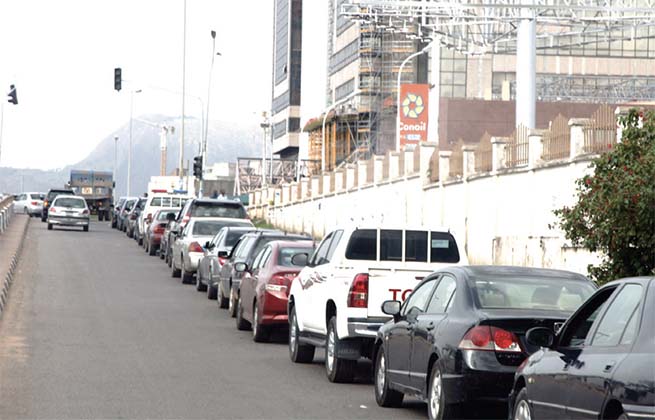
Oil marketers have explained that the reappearance of queues at filling stations in many states is because of the halt in the supply of petroleum products by dealers in a bid to avert losing their assets due to the ongoing nationwide hunger protests.
Many states in Nigeria, including the Federal Capital Territory, Abuja, witnessed varying degrees of queues about two weeks ago, which the Nigerian National Petroleum Company Limited blamed on a “hitch in the discharge operations of a couple of vessels.”
While the company and stakeholders worked together to tackle the challenge, the nationwide protest against hunger and economic hardship commenced on Thursday, August 1, 2024, disrupting petrol supply again and causing the reappearance of queues in some states.
The National Public Relations Officer of the Independent Petroleum Marketers Association of Nigeria, Chief Chinedu Ukadike, told our correspondent that marketers were advised to close their stations during the protest to avoid losing their assets.
He also stated that many tankers did not load products during the first and second days of the protest, stressing that this distortion in the supply chain would cause shortages in states where the products would have been supplied.
“Although the National President of IPMAN, Abubakar Maigandi, urged independent marketers to go out and do their businesses normally and asked the security agencies to protect our facilities, it is pertinent to note that as at the time we were about to sell, we were called by the security agencies to step down the selling of products at that time.
“They said this is because they want to be able to control the situation during the protest and the vandalism of marketers’ properties. Now that the trucks are no longer moving due to this protest, the depots are not working, the truck drivers are not driving, particularly during the first and second days of the protest, these issues have disrupted the supply of petroleum products. So it will result in scarcity at the filling stations,” Ukadike stated.
READ ALSO:
Hardship Protest: Business, commercial activities on hold in Ibadan
On Friday, newsmen reported that the hunger protest halted petrol loading at the Lagos depots, causing fuel scarcity to persist.
Sources confirmed to reporters that the depot owners refused to open for business over fears of violence.
An operator who pleaded anonymity stated that members of the Nigeria Union of Petroleum and Natural Gas Workers were ready to support the depots in loading fuel. Still, the depot owners refused to take a risk.
“There were no activities at the Lagos depots on Thursday and Friday for two obvious reasons. One, we are still battling the paucity of the product; and two, the security concern on the roads after loading due to the hardship protest.
“NUPENG is ready to support depots to load, but the security situation is a drawback. Hopefully, if the situation improves later today loading may continue tomorrow,” the source had stated.
The IPMAN official, however, stated on Sunday that some trucks had commenced skeletal operations, and expressed hope that the fuel supply situation would improve provided the protests abate considerably.
“But now that some trucks have started skeletal operations and businesses are gradually resuming, the independent marketers will also return to business to address the fuel scarcity. However, it will not disappear immediately, rather it is going to clear gradually.
“So it is important to state that the protests, particularly during the first and second days, truncated the supply value chain, leading to fuel scarcity in many states. So it is the ripple effect of the protest that we are feeling now as fuel scarcity, but we hope to clear it.
“I will also want to use this opportunity to call on the protesters to stop the protests. The President has pleaded with them and has heard their demands. Let us therefore give him time to act by addressing these demands. And this can only be done when the protests stop,” Ukadike stated.
Scarcity in states
Meanwhile, many states including Lagos, Abuja, Katsina, and Delta, among others, witnessed varying levels of fuel scarcity on Sunday.
Scarcity of petrol was experienced in Warri, Delta State, and environs on Sunday as the commodity was dispensed at filling stations in the metropolis at between N850 and N1,000/litre.
Most dealers attributed the scarcity to the non-loading of products at the depots by members of the Petroleum Tanker Drivers due to the ongoing nationwide #EndBadGovernance protest.
They however expressed hope that normalcy would return if and when the protesters sheath their swords and return to work.
In Asaba, the Delta State capital, fuel was sold at N1,000/litre on Sunday, as queues resurfaced at the filling stations.
In Rivers State, petrol was sold at between N850 and N870/litre at filling stations in Port Harcourt and its environs.
In the aftermath of the protests, fuel was scarce on Thursday and Friday and most filling stations were closed for fear of being attacked by irate youths.
But on Saturday, the fuel stations gradually returned and were selling between N870 and N850/litre.
In Akwa Ibom State, fuel was sold at between N870 and N890/litre, as filling stations in the state dispensed fuel without any queues.
In Edo State, few filling stations opened on Sunday to attend to customers, and this was due to the ongoing nationwide protest, as there were few vehicles around the city.
The fuel stations that opened for business sold for between N800 and N830/litre, with few vehicles in the queues waiting to be attended to.
The price of petrol in the Enugu State capital was between N780 and N890/litre on Sunday. While major marketers dispensed it at N780/litre, independent dealers sold it at between N850 and N890/litre. In the black market, a litre was sold at N1000/litre in Enugu.
Kaduna residents faced a challenging Sunday as no fuel station was open to the public, leaving motorists and road users stranded.
The few stations that operated, like Future View around Sabo Area, sold fuel at an exorbitant price of N860/litre, with no queues due to the ongoing #endbadgovernance protest that kept people indoors.
Major fuel stations and independent marketers shut their doors, while some remained locked as of Sunday evening when this report was filed.
However, black marketers took advantage of the situation, selling fuel at an inflated price of N1000/litre in some areas and N4,500/gallon in others.
The fuel scarcity and price hike added to the woes of Kaduna residents already reeling from the protests and uncertainty. The situation remains dire, with no indication of when fuel stations will resume normal operations.
In Gombe State, black marketers sold petrol at N1,200/litre.
Confirming this, a resident in the state, Johnson Mamedu, said, “I bought fuel for N850 and to get it immediately at the roadside from black marketers it is N1,200. I really don’t know where we are going to in this country.”





https://t.me/s/Martin_casino_officials