

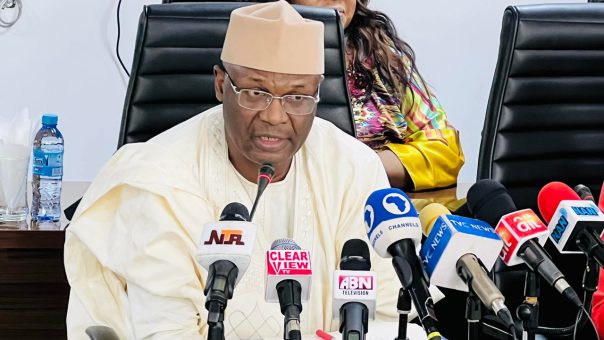
Independent National Electoral Commission (INEC) is shopping for cash to conduct by-elections to fill vacant seats in the National Assembly and some Houses of Assembly constituencies.
The lack of funds is stalling polls to fill the 16 vacant positions in 12 states, it was learnt.
The electoral agency is already in the breach of Section 76(2) of the Constitution which prescribes a by-election into a vacant seat within one month.
Besides, the Senate has passed a resolution directing INEC to hold elections into the two vacant seats in the Red Chamber.
Prior to the Senate resolution, the House of Representatives had in February resolved to investigate the delay in conducting by-elections by the commission as provided for in the Electoral Act.
The House directed its Committee on Electoral Matters to invite the leadership of INEC to provide a detailed explanation of the reasons behind the delay.
The two senatorial seats are Edo Central vacated by Senator Monday Okpebholo who is now Edo State governor and Anambra South which became vacant by the death of Senator Ifeanyi Ubah. Both seats were held by the All Progressives Congress (APC).
The five vacant House of Representatives seats are in Edo, Oyo, Kaduna, Jigawa and Ogun states.
The remaining nine seats are in Houses of Assembly.
For the House of Representative, Edo State Deputy Governor Denis Idahosa vacated his Ovia North/South Federal Constituency seat following election.
The remaining four seats in the House of Reps became vacant as a result of deaths.
These are : Isa Dogonyaro (Garki/Babura, Jigawa); Ekene Abubakar Adams (Chikun/Kajuru, Kaduna State); Olaide Akinremi (Ibadan North, Oyo State) and Oriyomi Adewunmi Onanuga (Ikenne/Sagamu/Remo North, Ogun State)
Read Also:
Rivers: Seats of 27 defected lawmakers declared vacant by assembly
At the first quarterly meeting of the Commission with members of the Inter-agency Consultative Committee on Election Security in February, INEC Chairman Prof. Mahmood Yakubu explained that the commission has 16 outstanding by elections to conduct.
Yakubu’s spokesman Rotimi Oyekanmi told The Nation that the Commission must get the required resources to conduct the elections.
He also said that the Commission will issue a timetable when it is ready to conduct the by elections.
The laws of the land, including the 1999 Constitution and the Electoral Act provide that all constituencies be represented in Parliament, the Electoral Act 2022 did not make any specific provision on the conduct of such by elections.
No single section of the law deals with by-elections explicitly. However, according to the Electoral Act 2022, by-elections are typically held to fill vacant seats in the National Assembly or State Houses of Assembly.
The Electoral Act 2022 provides guidelines for the conduct of by-elections, including the process for nominating candidates, the timeline for the election, and the procedures for voting and counting.
In a motion on the delay in conducting by elections adopted on the February 19 by the House of Representatives, Jafaru Leko (APC, Bauchi), said INEC, which was established pursuant to Section 153(f) of the Constitution of the Federal Republic of Nigeria, 1999 (as amended), is the sole body vested with the responsibility of conducting elections for the federal States, Federal Capital Territory (FCT) and the Area Councils of the FCT.
According to the Bauchi lawmaker, Sections 47 and 90 of the Constitution, (as amended), outlines the establishment of the National Assembly and the State Houses of Assembly, ensuring the right of citizens to be represented in the federal and state legislative bodies.
He said: “Since 2023 general and subsequent elections, there have been instances of resignations, deaths, appointments, or appointments of former members of both the National and State Assemblies to executive positions.
“Section 68 of the Constitution provides for the cessation and vacation of seats of the National Assembly, whereas section 76(2) stresses the need for a bye-election to be conducted not later than one month after the vacancy occurs.
“Upon the declaration of these seats as vacant, the INEC is obligated, under the provisions of Section 76(2), to conduct by-elections to fill the vacant positions and ensure proper representation of the affected constituencies.
“Nigeria practices a constitutional democracy that the continued vacancy of these seats, without the holding of timely by-elections results in the disenfranchisement of the affected, citizens, which constitutes a violation of the constitutional principles of representation and deprives the electorates of their right to adequate representation.
“The delay in conducting the by-elections for the vacant seats is a contravention of constitutional provision, a breach of the due process and denial of the affected constituencies’ proper representation.”
He warned that electoral body’s “inaction sets a dangerous precedent, where compliance with the Constitution and electoral laws becomes optional rather than mandatory”.








https://t.me/s/Top_BestCasino/173
https://t.me/dragon_money_mani/36