

/ Aug 17, 2026
/ Aug 17, 2026

El-Rufai sues ICPC for ₦10bn over family access

Published on

By

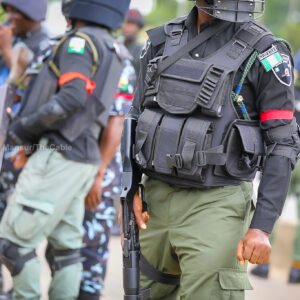
Former Kaduna State Governor Nasir El-Rufai has filed a fresh ₦10 billion lawsuit against the Independent Corrupt Practices and Other Related Offences Commission (ICPC), alleging that the agency unlawfully denied his wife and son access to him while he was in custody.


According to Channels Television, the suit was filed by El-Rufai’s lawyer, Ubong Akpan, at the Federal High Court in Abuja on August 13, 2026. The case, marked FHC/ABJ/CS/1852/2026, also lists the ICPC chairman and the Attorney-General of the Federation as defendants.

El-Rufai is asking the court to declare that his fundamental rights under Part IV of the 1999 Constitution remain enforceable despite his detention.

The former governor alleges that his wife, Aichatou Asabe, and his son, Abba El-Rufai, were repeatedly prevented from seeing him while he was in ICPC custody.

He claims the denial of access prevented his family from providing him with food, medication and other necessities, which he said was done without lawful justification or a court order.

El-Rufai further alleged that ICPC officers physically restrained and intimidated his wife and son on July 7, describing the incident as unlawful interference with his family relationships.

He argued that the alleged actions violated his constitutional rights to dignity and private and family life, citing Sections 34 and 37 of the Constitution, as well as Articles 5 and 18 of the African Charter on Human and Peoples’ Rights.

The former governor is seeking nine reliefs from the court, including declarations that the alleged denial of family access was unconstitutional, illegal, null and void.

He is also seeking ₦10 billion in compensation for the alleged violation of his fundamental rights.


You May Like

Leave a Reply

Your email address will not be published. Required fields are marked *

Most Popular

Must Read

Ebola response volunteers in protective equipment prepare to recover a suspected Ebola victim in Bunia, DR Congo.

Ebola outbreak in DR Congo becomes deadliest in history

The Ebola outbreak in the Democratic Republic of Congo (DRC) has become the deadliest in the country’s history, with 2,325 people confirmed dead as of August 16, 2026.   Government figures show that 4,945 confirmed cases have now been recorded, surpassing the previous national record of 2,299 deaths during the 2018-2020 outbreak. The latest figures come as the United Nations warns that the outbreak is spreading at an unprecedented pace. UN humanitarian chief Tom Fletcher described it as the “fastest-growing on record” and said the virus is now killing about one person every 30 minutes. Outbreak spreads across six provinces The outbreak was first declared on May 15 after emerging in Ituri Province in northeastern DRC. It has since spread to six provinces, raising concerns about further transmission across the region. The current outbreak is the DRC’s 17th Ebola outbreak and is being driven by the Bundibugyo strain. Unlike the Zaire strain responsible for several previous major outbreaks, there are currently no approved vaccines or treatments specifically available for the Bundibugyo strain. Experimental vaccines and treatments are being evaluated. Health authorities are facing major challenges, including delayed diagnosis, weak healthcare infrastructure, insecurity and difficulties tracking people who have come into contact with infected patients. The case fatality ratio has risen sharply, reaching about 46 per cent, according to the latest government figures. Health experts say the increase reflects delays in detecting and treating patients rather than evidence that the virus itself has become more lethal. Second-deadliest Ebola outbreak globally Although the DRC outbreak is now the deadliest in the country’s history, it remains below the scale of the 2014-2016 West African Ebola epidemic. That outbreak killed more than 11,300 people across Guinea, Liberia and Sierra Leone and remains the deadliest Ebola outbreak ever recorded. The current DRC epidemic, however, has reached the 2,000-death mark far more rapidly. It took nearly five months for the West African outbreak to reach 1,000 deaths, while the DRC outbreak crossed 2,000 deaths in less than three months. The World Health Organization has said it hopes to reverse the spread of Ebola in the DRC within three months, but the rapid expansion of the outbreak continues to put pressure on health workers and response teams.
Read more

Editor's Pick

Trending News

Newsletter

Enter your email address and receive notifications of news by email.

You have been successfully Subscribed! Ops! Something went wrong, please try again.

© 2026 GongNews. All Rights Reserved.