
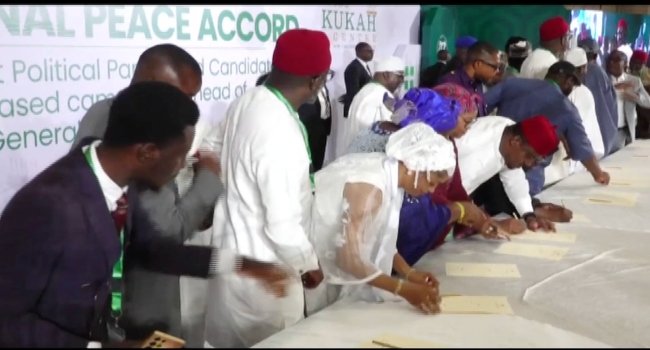
Peter Obi, Omoyele Sowore, and other political candidates have signed the National Peace Accord ahead of Nigeria’s 2027 general elections.
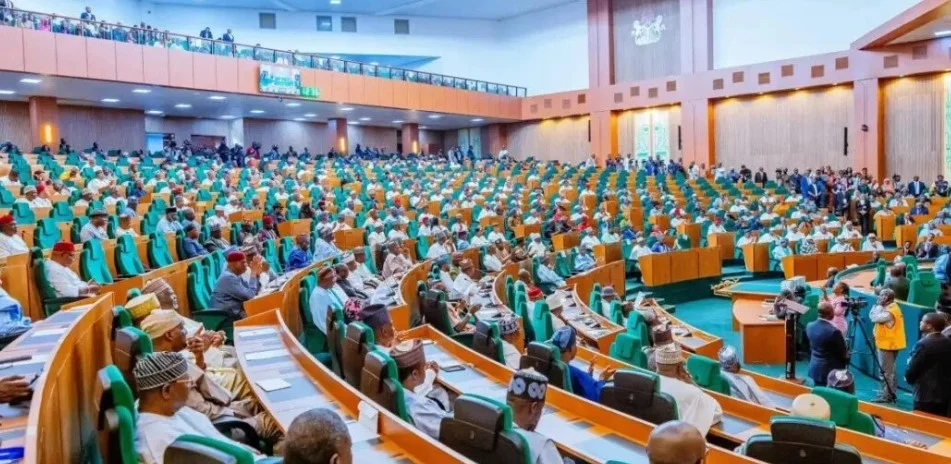
The agreement was signed on Tuesday at the Bola Ahmed Tinubu International Conference Centre in Abuja, a day before campaigns for the presidential and National Assembly elections are scheduled to begin.
The ceremony, organised by the National Peace Committee (NPC), brought together presidential, governorship and National Assembly candidates, political party leaders, the Independent National Electoral Commission (INEC) chairman, Joash Amupitan, and other political stakeholders.
Obi, the presidential candidate of the Nigeria Democratic Congress (NDC), called for a credible election in which Nigerians’ votes would count.
“I don’t have any fear [going into next year’s election] except to say that, please, for the sake of the children of Nigeria, can we have an election where people’s votes will count?” he said.
The former Anambra State governor also urged Nigerians not to vote for candidates who violate the terms of the peace accord.
He said contestants should conduct themselves properly, stressing that political officeholders must demonstrate the qualities expected of people entrusted with public responsibility.
Sowore, the presidential candidate of the African Action Congress (AAC), and the presidential candidate of the Peoples Redemption Party (PRP), alongside other candidates, also signed the accord.
President Bola Tinubu, who was represented at the ceremony by Secretary to the Government of the Federation, George Akume, commended the National Peace Committee for sustaining the initiative since it was first introduced ahead of the 2015 elections.
Tinubu reaffirmed the commitment of the ruling All Progressives Congress to the agreement and rejected electoral violence, hate speech, misinformation and incitement on social media.
He also cited technological improvements, including the Bimodal Voter Accreditation System, as contributing to greater transparency in recent off-cycle elections in Anambra, Osun and Ekiti.
Meanwhile, INEC Chairman Joash Amupitan said the commission had no preferred candidate or political party.
“INEC has no interest in who wins or loses any election. The commission does not have a candidate, nor does it favour any political platform,” he said.
Amupitan urged politicians to make the 2027 campaign a contest of ideas, saying Nigerians wanted solutions rather than insults.
He disclosed that preparations for the elections were progressing, with INEC planning logistics for about 1.4 million ad hoc personnel across more than 176,000 polling units.
Bishop Matthew Hassan Kukah, a member of the National Peace Committee, also urged politicians to ensure that ordinary Nigerians experience measurable improvements in their lives.
The peace accord, first signed ahead of the 2015 elections, commits political parties and their candidates to peaceful conduct and issue-based campaigns before, during and after elections.