
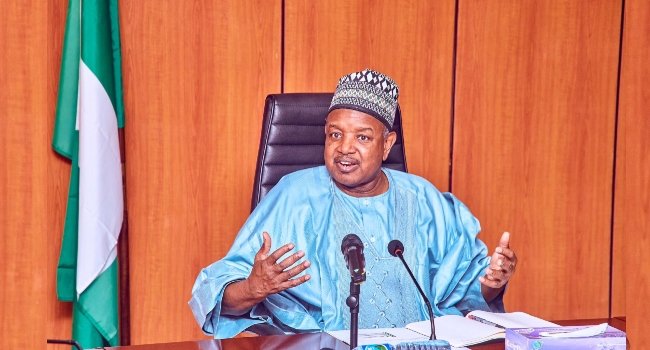
Nigeria’s national budget is among the smallest of the world’s 10 most populous countries, Minister of Budget and Economic Planning, Abubakar Bagudu, has said.
Bagudu made the statement on Monday at the Senate Press Corps Capacity-Building Workshop in Abuja, where he called for a broader national conversation on revenue mobilisation and the expansion of Nigeria’s fiscal space.
The workshop was organised around the theme, “Leveraging Legislative Oversight and Media Collaboration to Safeguard the National Budget from Unlawful Insertion.”
The minister said Nigeria’s population and development needs raised questions about whether the country’s current level of public spending was sufficient to achieve its development objectives.
“Out of the top 10 most populous countries in the world, we have the smallest national budget,” Bagudu said.
He asked Nigerians to consider whether the country should continue with its existing budget structure or explore ways to mobilise additional resources for development.
Bagudu also urged journalists to scrutinise budget provisions thoroughly and avoid concluding that unfamiliar allocations were irregular without investigating their origin, purpose and beneficiaries.
He said effective budget oversight should consider the constitutional roles of the Executive and National Assembly, as well as the rationale behind spending decisions and the development needs they are intended to address.
The minister linked the revenue and spending debate to President Bola Tinubu’s Renewed Hope Agenda and the country’s long-term development plans under Agenda 2050.
He said achieving the ambition of building a $1tn economy would require Nigerians to confront difficult questions around revenue generation, public expenditure and borrowing.
Bagudu further stressed the importance of public confidence in major fiscal decisions, saying citizens’ understanding and support were essential to the ability of the government and National Assembly to implement significant economic policies.
On alleged budget insertions, the minister cautioned against assuming that every unfamiliar provision was unlawful.
“We are dealing with human processes and human errors. Therefore, vigilance is necessary, and the media and legislative oversight should remain vigilant,” he said.
He also called for balance between budget transparency and national security, noting that disclosure of some sensitive information could have implications for strategic interests.
According to an August analysis by PUNCH Online, the combined budgets of Nigeria’s 36 states and the Federal Capital Territory increased by 47.5 per cent from N27.22tn in 2025 to N40.14tn in 2026.
However, the share allocated to capital projects declined from 73.24 per cent to 64.34 per cent, although the actual capital expenditure rose from N19.94tn to N25.83tn.
The Federal Government’s 2026 budget is N68.32tn.