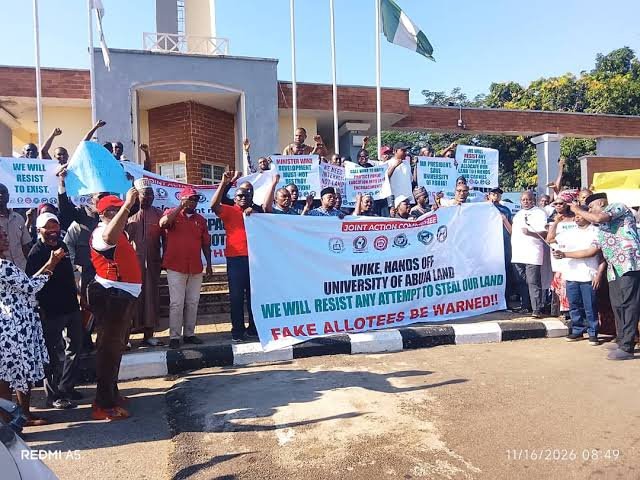
Academic and non-academic staff, students and alumni of the University of Abuja on Monday protested against the Federal Capital Territory Administration’s decision to reduce the institution’s land allocation, demanding President Bola Tinubu’s intervention.
The protest involved five university groups, including the Academic Staff Union of Universities, Senior Staff Association of Nigerian Universities, Non-Academic Staff Union of Educational and Associated Institutions, the Students’ Union Government and the university’s alumni association.
The protesters accused FCT Minister Nyesom Wike of disregarding the rule of law by allegedly reallocating portions of the university’s land to private individuals and organisations.
Speaking during the protest in Abuja, the Chairman of ASUU’s University of Abuja branch, Sylvanus Ugoh, said the land was allocated to the institution when it was established in 1988 and should not be transferred for private interests.
He described the alleged reallocation as an attack on public education and called on President Tinubu to direct the minister to reverse the decision.
“University is a public good; university is public interest. There is nowhere in the world where you take public interest for individual interest,” Ugoh said.
He warned that the dispute could undermine the Federal Government’s assurances that universities would not experience industrial action under the current administration.
Similarly, SSANU branch chairman, Nurudeen Yusuf, said the unions would resist any attempt to take over the institution’s land, stressing that adequate space was essential for academic expansion and research.
He cited the university’s Nuclear Engineering and Aeronautical Engineering departments, explaining that specialised programmes required sufficient land for research, practical training and other academic activities.
The unions also threatened legal action and possible industrial action if the FCTA failed to reverse the disputed decision.
FCTA Defends Wike’s Decision
However, the FCTA dismissed the protest as misplaced, insisting that Wike was implementing recommendations approved by his predecessor, former FCT Minister Mohammed Bello.
In a statement issued on Monday by the minister’s Senior Special Assistant on Public Communications and Social Media, Lere Olayinka, the administration said a joint committee established in 2016 had recommended a reduction in the university’s landholding.
According to the FCTA, the committee was inaugurated on November 10, 2016, to examine the university’s land size, encroachment by indigenous settlers, illegal developments around its Gwagwalada mini-campus and the issuance of title documents for its campuses.
The committee, which had 12 members, included five representatives of the university.
The administration said the committee recommended that the university’s landholding of more than 11,000 hectares be reduced to 100 hectares, in line with the size it attributed to the National Universities Commission’s recommendation.
It added that Bello approved the committee’s recommendations.
Olayinka, however, disclosed that Wike approved 4,519.80 hectares for the university, rather than the 100 hectares recommended by the committee.
The FCTA maintained that the retained land could accommodate more than 80,000 buildings, using a plot size of 500 square metres.
It also accused the university of allocating portions of its land to individuals and corporate organisations without consulting the administration, citing the Economic and Financial Crimes Commission among the beneficiaries.
Dispute Dates Back to 2025
The controversy dates back to June 2025, when Wike announced plans to reclaim approximately 7,000 hectares of land originally allocated to the university.
The minister had accused the institution of occupying and fencing off extensive portions of government land without adequate documentation.
He subsequently directed the FCTA to make the reclaimed areas available for other developments in Giri District.
The university management and ASUU have consistently maintained that the original land allocation was legitimate and necessary for the institution’s long-term development, including academic expansion, agricultural research and infrastructure.
The university’s Pro-Chancellor, Olanrewaju Tejuoso, had also questioned the quality of the land remaining with the institution, arguing that much of it comprised rocky hills.
The dispute has since moved to court.
The university instituted Suit No. FCT/HC/CV/3500/2026 before the High Court of the Federal Capital Territory, Maitama.
According to the report, Justice F.E. Messiri, on August 18, 2026, ordered the parties to maintain the status quo ante bellum concerning Plot No. 1, Giri District, pending the determination of the substantive case.
ASUU subsequently accused the FCTA of violating the court order through alleged allocations of portions of the disputed land to private individuals and companies on September 26, 2026.
The protesting unions have urged the Federal Government to intervene and resolve the dispute to prevent a disruption of academic activities at the university.