

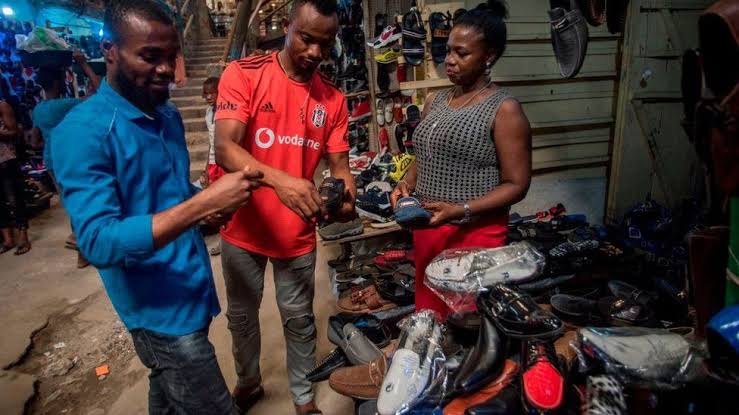
A Professor of Marketing at the Lagos Business School in Pan-Atlantic University, Lagos State, Ogechi Adeola, has explained why the Igbo apprenticeship is the largest business incubator system in the world.
Adeola, who is the Head of the Department Marketing, Operations and Information Systems at the LBS, while speaking at the 15th Inaugural Lecture of the institution titled, “Decolonising Africa’s Business Practices: Pro-Indigenous Marketing Pathways To A Paradigm Shift”, monitored on Friday, said Igbo apprentices are groomed at a very young age to be great businessmen and women.
She leveraged her research on a couple of books she had authored and co-authored including ‘Indigenous African Enterprise’ and ‘Igba boi’ which she said gave an insight into the Igbo apprentice system commonly referred to as ′Igba-Odibo/Igba-Boi/Imu-Ahia/Imu-Oru′ is a framework of formal and informal indentured agreements between parties that ultimately facilitate burgeoning entrepreneurial communities within the Igbo people.
“The system has three major types namely, Igba-boi also known as Igba Odibo (become an apprentice); Imu Oru also known as Imu Oruaka (learn a craft) and Imu Ahia (learn a trade).
“All types are geared towards the transfer of knowledge or entrepreneurial skills but they differ in approach.
“Unlike the Igba-boi/Igba Odibo where a mentee will be tutored for free for a period of pre-agreed years, in the Imu Oru/Imu Oruaka and Imu Ahia types, tutorship is paid for by the mentee or mentee’s parents/sponsors.
Read Also:
Imo govt warns business owners to open from Monday or risk shutdown
The professor cited an understudy done by an American journalist, Robert Neuwirth, in a 2017 TedTalk presentation that described the Igbo people’s ‘Igba Boi’ scheme as “the largest business incubator platform in the world”.
She said Neuwirth looked at the Alaba International Market, where 10,000 merchants do business for over $4bn a year, and identified the sharing principle behind it.
She spoke further about what ignited her deep interest in Africa referencing it to The Economist’s ‘Hopeless Continent’ article in 2000 that declared the new millennium as one that has “brought more disaster than hope to Africa”.
She also shared her journey towards reshaping the ‘wrong’ characterisation in the article and others including Time’s tripartite – Agony of Africa, The Hopeless Continent and Aids in Africa published in 1992, 2000 and 2001 respectively while writing against them all to protect the Africa of her dream at a very tender age.
However, Adeola said she was pleased to read The Economist publication of December 3, 2011, titled, Africa Rising’ appraising African ethos saying, “I could see the sun. Africa now has a real chance of following in the footsteps of Asia. So, from a hopeless continent to a rising one.”
The academic pleaded with youths leaving the country to put Africa in the spotlight by marketing the continent as a sellable point to the world.
Among those in attendance at the event were the institution’s Vice Chancellor, Prof Enase Okonedo; Registrar, Mr Kingsley Ukaoha; Dean of Media and Communication, Dr Ikechukwu Obiaya; Associate Dean of LBS, Prof Olayinka David-West; Dean of Science and Technology, Dr Darlington Ahano; husband, siblings of the lecturer and other well-wishers.















https://t.me/s/BeeFcAsiNo_OffIcIaLS