
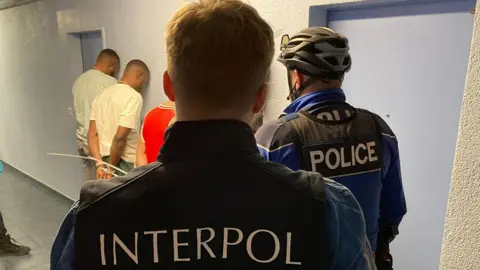
The International Criminal Police Organisation has arrested more than 300 people with links to one of West Africa’s most feared criminal networks, Black Axe, and other affiliated groups.
In a series of covert missions, tagged, “Operation Jackal III” in 21 countries between April and July 2024, Interpol said the highly-coordinated cybercrime group was responsible for some of the world’s cyber-enabled financial fraud and many other serious crimes, BBC reports Wednesday.
While the police labelled the operation as a “major blow” to the Nigerian crime network, it equally warned of its worldwide reach and technological sophistication — making the Black Axe a global threat.
The report noted that Operation Jackal III had led to the seizure of $3 million of illegal assets and more than 700 bank accounts being frozen.
A senior official at Interpol’s Financial Crime and Anti-Corruption Centre, Tomonobu Kaya, stressed the significance of financial technology and cryptocurrency in aiding the operations of cybercrime syndicates which are renowned for multi-million dollar online scams.
READ ALSO:
Crime: Cultists kill Police Inspector in Lagos
He said, “They are very organised and very structured. These criminal syndicates are early adopters of new technologies… A lot of fintech developments make it easy to illegally move money around the world.”
The Black Axe is a secretive criminal network involved in trafficking, prostitution and killing operations around the world. However, cybercrime is the group’s largest source of revenue.
The report noted that several members of the dreaded group are university-educated and were recruited into the group during their schooling.
In a 2022 report by Interpol, it said, “Black Axe and similar groups are responsible for the majority of the world’s cyber-enabled financial fraud as well as many other serious crimes.”
Multiple so-called “Jackal” police operations have taken place since 2022. Dozens of Black Axe and other gang members had been arrested and their electronic devices seized during these transnational raids.
In one example, Canadian authorities said they busted a money-laundering scheme linked to Black Axe worth more than $5 billion (£3.8bn) in 2017.
Dealing with highly sophisticated criminal groups requires a high level of technological expertise and personnel.
Interpol said it had launched the Global Rapid Intervention of Payments system which enables the authorities in its 196-member countries to freeze bank accounts around the world with unprecedented speed.
The mechanism was used to halt a $40m scam targeting a Singaporean business in July 2024, the police said.
Kaya noted, “We need to have data and to collate our findings from these countries to help build a picture of their modus operandi. If we can gather this data, we can take action.”
In his view, the West Africa Regional Coordinator from the Institute for Security Studies, Dr Oluwole Ojewale, blamed the government for its laxity in curtailing criminal groups such as the Black Axe, among others.
He also said politicians use members of these syndicates for their gains, providing them with the necessary tools to defraud innocent people and commit other atrocities.
“The general failure of governance in the country has put pressure on people to be initiated (into the Black Axe). It is the politicians who are arming these boys,” he asserted.
Ojewale added that “the emphasis must be on prevention not on outright operations against these criminal groups.”
President Bola Tinubu, in February 2024, pledged increased support for the Economic and Financial Crimes Commission to increase its capacity to tackle digital offences.
This was as he deplored what he termed “mislabelling and blanket stereotyping” of Nigeria as a country with the highest prevalence of cybercrime and other forms of corrupt practices among its population.
In November 2023, the Nigerian Senate expressed concerns over an annual loss of $500m to various forms of cybercrime across the country.
It warned that if the national cybersecurity programme was not effectively funded, the gains of the digital economy would be defeated.
The report also recalled that Interpol’s Jackal Operations originated from Ireland.
In 2020, the Garda National Economic Crime Bureau identified 1,000 people with links to Black Axe and arrested several members, paving the way for the exposure of a far wider network.
A detective superintendent at the GNECB, Michael Cryan, who led the operation, said Ireland had experienced a surge in money laundering, owing to the criminal acts of the Black Axe.
“They were very under the radar, very low-key. The amount of money being laundered through Ireland was astronomical.
“Bank robberies are now done with laptops – they are far more sophisticated. This is not a typical or ordinary crime… People who make decisions need to know how serious this is,” Cryan said.
He estimated that €200m ($220m; £170m) had been stolen online in Ireland in the past five years and that only accounts for the 20% of cyber-crimes that are believed to be reported.
More than €1m in crypto-assets were also seized during one operation, the report added.