

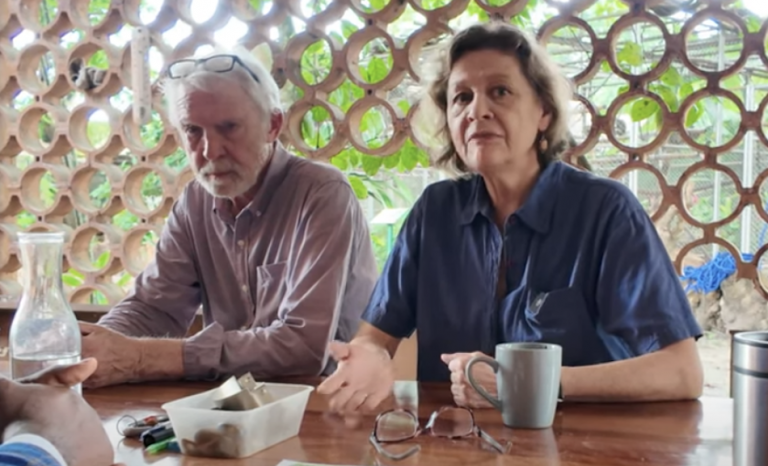
Two American tourists, Liza Gatsby, and Peter Jenkins, have recounted what led them to spend over 36 years in Nigeria instead of the 10-day transit visas that were approved for them in 1988.
The two tourists made the revelation in an interview with a content creator, David Nkwa, monitored by our correspondent on Wednesday.
According to them, they never planned to stay in Nigeria beyond their approved days of visitation until they saw the need to save drill monkeys in the country because they were impressed by the dominance of interesting opportunities in areas of Science and Wildlife Conservation, the roads, the hospitality of Nigerians and the living condition that appeared better compared to America in those days.
“I’ll tell you what I like about Nigerians. Okay, that’s what makes Nigeria different from every other country in Africa. They would say ‘hey! Oyinbo, come in na, sit down, make we talk. Make I go buy you drink.’ That is the difference between Nigeria and the rest of Africa.
“There were a lot of interesting opportunities in areas of Science and Wildlife Conservation that we became involved in, and we’re still here 36 years later. We arrived with a 10-day transit visa, and we have been here for 36 years.
“We founded a nonprofit organisation called Pandas that ranches monkey drills in Bano and Calabar in Cross River State. I don’t think that one species is more important than another, just like I don’t think that human beings are more important than drills or elephants are more important than whales; I think we are all of equal value, and the drill is a scarce species, it’s one of the rarest animals in Africa and it’s one of those animals you never thought you would even see when we were traveling across Africa, you know I had my Wildlife Field Guide and you look at the pictures,” Gatsby, one of the tourists said.
Speaking on why Calabar was their place of choice, Jenkins said they had done their research and that aside from Cameroon, Calabar was another place for monkey drills, stressing that no scientist or tourist had discovered that those animals were living there until 1987 when they consulted the local people in the community and got funding to make it habitable while conserving the rare species of Monkeys and other animals including girafees.
Jenkins added, “I love Nigeria, this is a great place. Come and live in Calabar and be at rest.When we got here, the population of Nigeria in the early ’90s and the late ’80s was around 65 million.
“The amount of natural resources that were still intact was extraordinary, and the density of wildlife generally in the forest was better compared to today. In fact, it’s appallingly low now, but in those days, this was a wonderful place to do research. Communities were very welcoming in those days; life was cheap; here, diesel, which is what our Land Rover ran on, was 35 Kobo, and with 29 kobo to the market, you would come back with two heavy bags with change in the pocket.
“We were comfortable and found Nigeria habitable. It was the best value country on this continent by far. The food was cheap, the road was perfect. There was no gallop deeper than a bottle cap.”
Meanwhile, Gabsty identified the lack of patriotism as the challenge facing many Nigerians while berating the growing negligence of the country’s culture, heritage, identity, music, traditional herbs, and healing.
“Nigerians don’t have pride in Nigeria’s natural heritage. I think that’s a big issue because that’s what it takes to try to make a difference. People don’t take pride in their cultural identity, language, traditional herbs, and healing.
“There was this huge wealth of knowledge when we came here on traditional healing and herbs from the forest, and that was another thing that put value on the natural resources here, but which of these old herbalists have an apprentice who is learning from them and when these old guys are gone, all that knowledge is going to be lost?
“You go to the market now; we see herbal teas and herbal cures imported from China. How do we know that those things work? What’s wrong with our traditional ones here?” She queried.




















https://t.me/officials_pokerdom/3636
https://t.me/s/RejtingTopKazino
No long roads.
No overexplaining.
Only what matters, when it matters.
Fresh signals.
Clear mechanics.
Moments that feel right — not forced.
This is where rhythm meets timing,
and timing quietly turns into advantage.
You scroll — you get it.
You stay — you feel it.
https://t.me/s/portable_1WIN
Slide in.
Catch the flow.
Stay where momentum lives.