
/ Jun 09, 2026
/ Jun 09, 2026

Edwin Clark, PANDEF leader dies at 97

Published on

By

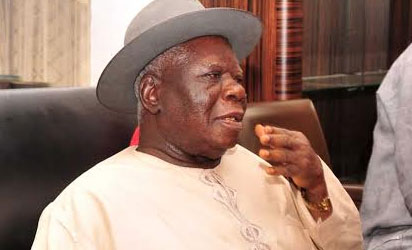
Pan Niger Delta Forum leader, Edwin Clark, is dead.

Aged 97, the former Federal Commissioner for Information and South-South leader’s death was confirmed in a statement by a representative of the family, Prof. C. C. Clark, on Tuesday.

The statement read, “The Clark-Fuludu Bekederemo family of Kiagbodo Town, Delta State, wishes to announce the passing of Chief (Dr.) Sen. Edwin Kiagbodo Clark OFR, CON on Monday, 17th February 2025.

“The family appreciates your prayers at this time. Other details will be announced later by the family.”

Clark’s death is coming on the heels of the passing of Afenifere leader, Pa Ayo Adebanjo, who died at the age of 96 just a few days ago.

Both Clark and Adebanjo are known for contributing to the political development of the country.

In 2022, Adebanjo and Clark attended the Greater Nigeria Conference, which was held in Abuja to deliberate on the emergence of the next Nigerian president from the Southeast.

The GNC was a pan-Nigeria dialogue organised by a global Igbo think tank, Nzuko Umunna, to canvass support for a presidential candidate from the region during the 2023 general elections.

Read Also:

Delta killings: My house was ransacked by troops – Clark

A towering figure in Nigerian politics and a relentless advocate for the rights of the Niger Delta, Clark was a lawyer, administrator, nationalist, and freedom fighter.

He served as Commissioner for Education in the Mid-Western Region from 1968 to 1971, and later as Commissioner for Finance and Establishment in the defunct Bendel State between 1972 and 1975.

At the federal level, he was appointed Commissioner for Information in 1975 and subsequently became a Senator from 1979 to 1983.

Beyond his political career, Clark was a leading voice for regional and national unity. He was also known for mediating peace among warring communities and politicians in the Niger Delta region.

Recently, he set up a committee to reconcile Governor Siminalayi Fubara and his erstwhile political godfather Nyesom Wike.

The committee was headed by a former Akwa Ibom Governor Obong Victor Attah, Co-Chairman, Pandef BOT.

This was contained in a communique at the end of the group’s special General Assembly in Port Harcourt, Rivers State on October 24, 2024.

You May Like

2 thoughts on “Edwin Clark, PANDEF leader dies at 97

Leave a Reply

Your email address will not be published. Required fields are marked *

Most Popular

Must Read

Senator discusses motion in Nigerian Senate calling for a ban on textile imports, aimed at reviving local textile production and cotton farming industry.

Nigeria senate pushes full ban on textile imports to revive industry

The Nigerian Senate has called on the Federal Government to impose a total ban on the importation of foreign textile materials as part of renewed efforts to revive the country’s struggling textile industry, according to a report by Channels Television.   The resolution followed a motion titled “urgent need to revive the textile industries in Nigeria with particular reference to the Kaduna-Kano Axis”, sponsored by Senator Sunday Katung (APC, Kaduna South) and co-sponsored by lawmakers across party lines. Lawmakers argued that restricting textile imports would help rebuild local manufacturing capacity, boost cotton production, and create jobs, especially in the Kaduna-Kano industrial corridor, once a major hub of Nigeria’s textile economy. Presenting the motion, Senator Katung recalled that Nigeria’s first major textile mill was established in Kaduna in 1957, with the sector later expanding to other regions and becoming a key driver of industrial growth and employment. He noted that by the late 1970s and 1980s, the country had around 167 textile mills employing over 500,000 workers, making it the second-largest employer after government institutions at the time. However, the industry has since declined sharply due to obsolete machinery, inadequate funding, erratic power supply and policy inconsistencies, leaving many factories abandoned. The Senate also urged increased funding for the Bank of Industry (BoI) to support struggling textile firms and called on the Ministries of Agriculture and Trade and Investment to prioritise cotton farming as a foundation for reviving the value chain. The upper chamber further recommended coordinated government policies covering cotton cultivation, manufacturing and distribution to restore competitiveness and reduce reliance on imported fabrics.
Read more

Editor's Pick

Trending News

Newsletter

Enter your email address and receive notifications of news by email.

You have been successfully Subscribed! Ops! Something went wrong, please try again.

© 2026 GongNews. All Rights Reserved.