

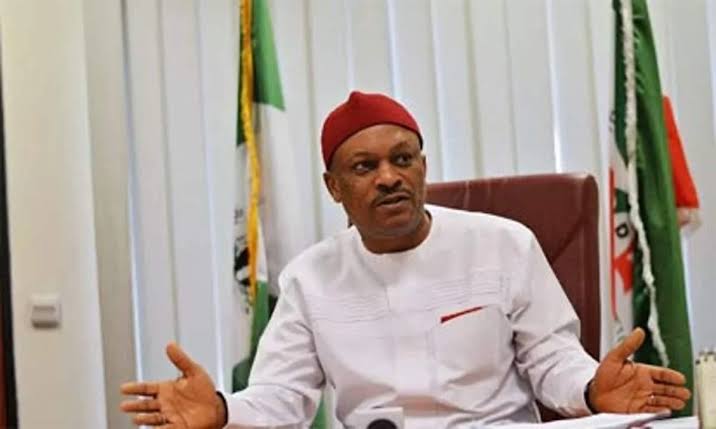
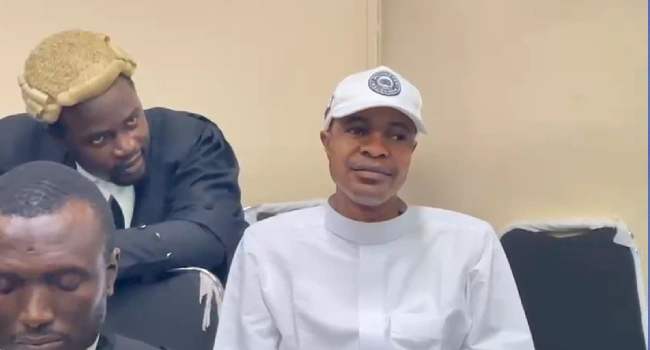
The Supreme Court of Nigeria on Monday reserved judgment in the appeal filed by the embattled Secretary of the Peoples Democratic Party, Samuel Anyanwu, challenging his removal from office.
Anyanwu, in his appeal, seeks to overturn the judgment of the Court of Appeal, Enugu, which upheld the December 20, 2024 verdict of the Federal High Court removing him as PDP National Secretary.
In a 10-ground appeal filed through his counsel, Ken Njemanze (SAN), Anyanwu urged the apex court to allow his appeal and set aside the lower court’s decision, which recognised Sunday Udey-Okoye as the new PDP National Secretary.
The respondents in the appeal, marked SC/CV/82/2025, include Aniagu Emmanuel, PDP, Ambassador Iliya Damagun (PDP acting National Chairman), and High Chief Ali Odefa (National Vice Chairman, Southeast Zone, PDP) as the first to fourth respondents.
Anyanwu, in the appeal, argued that the lower court erred in law by assuming jurisdiction over an internal party matter.
He contended that party leadership and membership issues are non-justiciable and beyond the jurisdiction of any court.
Additionally, he criticised the lower court for failing to determine whether the plaintiff had exhausted the mandatory internal dispute resolution mechanisms outlined in the PDP constitution before filing the suit.
Anyanwu also challenged the verdict of the lower court holding that the plaintiff had the locus standi to institute the case.
Read Also:
PDP fumes as El-Rufai criticises govt, urges APC to unite
Furthermore, he argued that the lower court misinterpreted Section 84(12) of the Electoral Act 2022, maintaining that he neither resigned nor was properly removed from his position.
He emphasised that the PDP constitution outlines specific procedures for the removal or resignation of party officers.
He also cited Article 47 of the PDP constitution, which stipulates a four-year single term for party executives, asserting that the lower courts had no basis for their concurrent findings that he had vacated his office.
During the hearing, all parties adopted their processes, except for PDP and Damagun, who did not file any documents. The respondents unanimously urged the court to dismiss the appeal.
Senior counsel Erokoro, citing Ali Modu Sheriff vs PDP, urged the Supreme Court to depart from its previous position that courts lack jurisdiction over political party disputes.
He argued that Anyanwu had resigned and that the trial court had already ruled on the matter.
“The lower court held that he resigned because the constitution mandates resignation before contesting an election,” Erokoro stated.
The Supreme Court, however, questioned, “Does the court have the power to decide who should hold an office?”
On his part, Njemanze insisted that the courts lacked jurisdiction to hear the case, as it pertained to the internal affairs of the PDP.
“My Lords, I adopt all the processes filed by the appellant and respectfully urge this court to allow the appeal,” Njemanze submitted.
“In all your judgments over the past year, you have consistently maintained that party leadership disputes are non-justiciable. The lower courts had no jurisdiction over this matter.”
Following Njemanze’s arguments, the five-member Supreme Court panel, presided over by Justice Uwani Musa Abba-Aji, reserved judgment to a later date, which will be communicated to the parties.
Meanwhile, earlier in the proceedings, the apex court struck out Anyanwu’s motion for a stay of execution.
Erokoro initially brought the court’s attention to the motion. Although the court first held that it could not take the application, Erokoro later requested its withdrawal.
“The stay of execution application is pending. It should be withdrawn so that it can be struck out,” he said.
Upon his submission, Njemanze applied to withdraw the motion.
“I apply to withdraw the application for a stay of execution filed on February 5, 2025,” he stated.
The respondents did not object, and the court proceeded to strike out the motion.
Justice Abba-Aji ruled, “The application for a stay of execution, filed on February 5, was withdrawn without objection from either party.”



https://t.me/officials_pokerdom/4091
https://t.me/iGaming_live/4872