

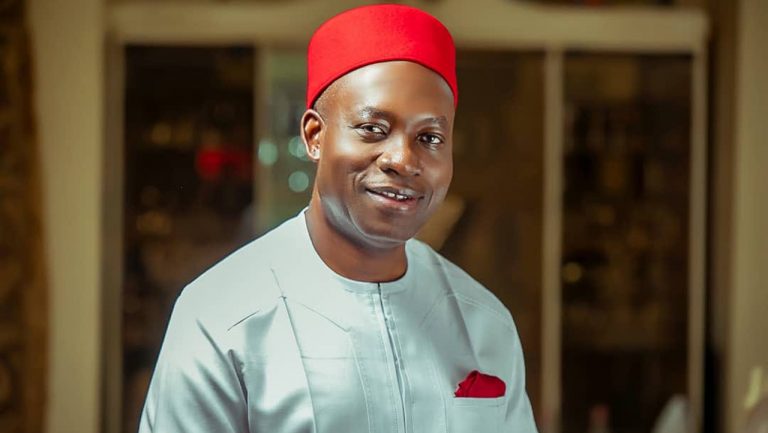
The Independent National Electoral Commission, INEC, on Sunday announced Governor Chukwuma Soludo as the winner of the November 8 governorship election in Anambra State.
Gong-news reported that the Returning Officer and Vice Chancellor of the University of Benin, Prof. Edogah Omoregie, made the declaration at the commission’s headquarters in Awka on Sunday.
Soludo contested on the platform of the All Progressives Grand Alliance, APGA, and polled 422,664 votes to emerge the winner of the election.
His closest rival, Prince Nicholas Ukachukwu of the All Progressives Congress, APC, scored 99,445 votes to come second.
According to INEC, the candidate of the Young Progressives Party, YPP, Paul Chukwuma, secured 37,753 votes.
While George Moghalu, the candidate of the Labour Party, scored 10,576 votes, John Nwosu, the candidate of the coalition-backed African Democratic Congress, ADC, polled 8,208 votes.
When INEC declared Soludo winner of the Anambra State governorship election, few were surprised.
The victory reflected not only Soludo’s political strength but the disarray within the opposition.
Behind the numbers was a familiar story in Nigerian politics: one of fractured parties and internal rivalries that proved costly at the polls.
Labour Party’s internal turmoil
The Labour Party, once buoyed by the momentum of the 2023 general elections, entered the Anambra governorship race deeply divided. Competing factions loyal to different national chairmen produced parallel candidates, each claiming legitimacy. The pro-Abure faction backed a relatively unknown aspirant, while another camp rallied behind a former federal lawmaker.
The confusion over who the authentic candidate created voter apathy within the party’s base. By the time the courts intervened, campaign time had been lost, and resources dissipated in legal wrangling rather than mobilization.
In several local governments, LP supporters admitted they were unsure who truly represented the party.
“We were ready to vote Labour, but no one even came here to campaign,” said a resident of Nnewi South.
“They were fighting themselves while Soludo was busy working,” he added.
PDP’s leadership battles, defections
The Peoples Democratic Party, PDP, has continued to count its losses following the protracted leadership crisis bedevilling the party since the aftermath of the 2023 general election.
The once-formidable umbrella is now fraying under the weight of defections, protracted crisis, and loss of public confidence.
Recall that PDP was in a dilemma over the failure of aspirants to buy the party’s nomination form ahead of the Anambra election.
The PDP initially scheduled the sale of forms between 24 February and 5 March. It had set 7 March as the deadline for submission of the forms.
The development came after many aspirants rescinded their decision to buy forms because of the leadership crisis ravaging the party, particularly at the national level.
However, the party would later settle for an Abuja-based real estate developer, Chief Jude Ezenwafor, as its flag-bearer in the State governorship election.
Ezenwafor, who was the sole aspirant in the PDP race, was unanimously endorsed by 853 delegates from the 21 local government chapters of the party in the state.
He was the only aspirant to purchase the party’s N40m nomination form.
Vote buying
There were also reports that the election was also marred by irregularities, especially allegations of massive vote buying.
Several party leaders and candidates alleged vote buying in polling units across the state despite a series of warnings by the Independent National Electoral Commission, INEC, and the law enforcement agencies.
It was alleged that some party agents were paying between N20,000 and N30,000 to electorates, to vote for their candidates.
Voters around Awka South, alleged that APGA gave them N5,000 while APC offered as high as N10,000 to induce votes.
Speaking on Channels TV’s Sunday Politics, the candidate of the Labour Party, George Moghalu, blamed his loss in his polling unit on vote-buying by some of the contenders.
Moghalu specifically accused the ruling party in Anambra, the All Progressives Grand Alliance, APGA, of being the main culprit behind the alleged vote-buying activities.
He claimed that several party agents, some of whom had been arrested for vote-buying, were seen wearing APGA party tags.
Moghalu said that he could not afford to match the amount of money other candidates were offering voters, and as a result, he refused to engage in vote-buying.
He added that many voters in his polling unit succumbed to the temptation of money due to their financial struggles.
“Yes, because I couldn’t afford how much that was being paid. I couldn’t pay, and I refused to pay, I refused to get involved,” Moghalu said when asked if his loss in the polling unit was related to vote-buying.
“So, they have too much money to buy votes, and what do you expect my people to do? They fell because a lot of them are poor.
“Some of them are on record as having been seen purchasing votes. There’s even a commissioner who was also caught on camera buying votes in my particular constituency,” Moghalu claimed.
Soludo’s incumbency, strategic advantage
While the opposition imploded, Soludo capitalized on his incumbency and record in office.
His campaign emphasized visible infrastructure projects, education reforms, and economic initiatives.
The governor also leveraged APGA’s grassroots network, particularly in rural areas where the party has long-standing structures.
On election day, APGA agents dominated polling units across the state, while LP and PDP struggled to maintain representation.
The result was predictable- APGA swept the 21 local governments within hours of results’ collation, leaving little room for an upset.
INEC’s final tally confirmed Soludo’s sweeping mandate, while opposition figures blamed their loss on internal sabotage and lack of cohesion.
Expect similar results in 2027 – Analyst
Meanwhile, analysts say the 2025 Anambra election should serve as a warning for opposition parties ahead of future polls.
A public affairs analyst and communications specialist at Peaceland University, Enugu, Nduka Odo, said the election has proven again the state of opposition politics in the country
In a chat with newsmen on Sunday, Odo warned that the opposition should expect a similar result in 2027, if they don’t put their houses in order and work together.
He said: “The result of the Anambra gubernatorial elections has proven again the state of opposition politics in the country.
“Kudos to the APGA team for taking up almost all the votes, in spite of the recorded evidence of vote buying during the election. Since Peter Obi, APGA remains strong in Anambra.
“The shocking outcome of the election is that both PDP, LP, and ADC performed far below expectations of the populace. APC and YPP scored higher than them. This should serve as a serious lesson to those in opposition.
“They should expect a similar result in 2027. If they don’t put their houses in order and work together, the ruling party will have it all.
“The only way the opposition was able to sack PDP was by merging a formidable force today called APC. The current opposition needs to learn that if they want to go far.”










https://t.me/s/officials_pokerdom/3341
So, I stumbled upon u88888. Honestly, I was a bit skeptical at first, but I was pleasantly surprised. They have a pretty good variety of options, whatever you’re looking for. I found what seemed like some great deals! Give it a look!. u88888
https://t.me/s/be_1win/904
Table games are where it’s at! blackjack, poker… I’m in! Hopefully Tablegamecasinoplus has all the classics (and maybe a few surprises). Worth a punt, I reckon. See more at tablegamecasinoplus
b52cocktail I was really hesitant honestly, but it’s surprisingly fun! Worth a few spins. Take a shot at b52cocktail
I enjoy your piece of work, thanks for all the useful content.
It?¦s in point of fact a great and useful piece of information. I am satisfied that you simply shared this helpful info with us. Please stay us informed like this. Thanks for sharing.