

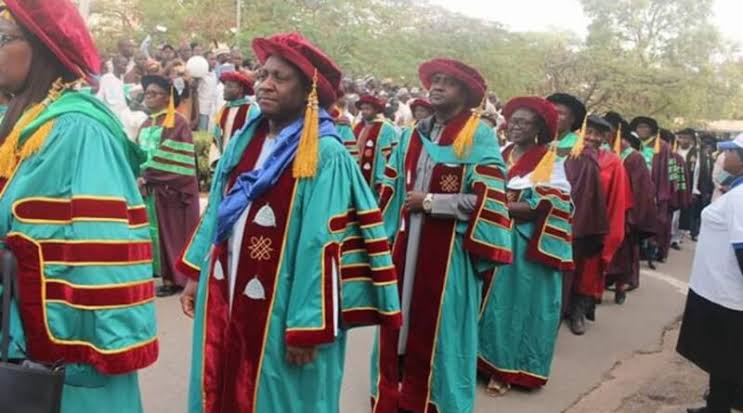
Universities in Nigeria are battling a severe shortage of staff as thousands of lecturers leave the tertiary institutions to seek greener pastures in foreign lands amid the high number of retirements at the varsities.
The Academic Staff Union of Universities branches in separate interviews with reporters on Sunday confirmed this, adding that the shortage was due to the surge in the exit of the lecturers out of Nigeria and the concerns around the Integrated Personnel and Payroll Information System.
ASUU at the Usmanu Danfodiyo University, Sokoto, said about 100 lecturers had left the university, while the union at the Federal University, Gusau, Zamfara, disclosed that the institution was in need of about 1,000 lecturers to fill the vacancies created by those who had left.
The union at the Federal University of Agriculture, Abeokuta, Ogun State said over 350 academic vacancies were available at the institution, while 27 lecturers had left two faculties at the University of Lagos, as 100 workers at the University of Uyo travelled out of the country.
The union disclosed that about 500 academic vacancies existed at the University of Ilorin in Kwara State, while both academic and non-academic staff of the Olusegun Agagu University of Science and Technology were leaving the country.
The Chairman, Olusegun Agagu University of Science and Technology, Okitipupa, Ondo State, Dr. Rotimi Olorunsola, said many of the staff of the institution, both academic and non-academic, had left the university.
Japa in varsities
Olorunsola said, “Yes, some have japa (travelled out of the country), both the academic staff and non-academic.”
The Head of the Media and Protocol, Adekunle Ajasin University, Akungba Akoko, Mr Victor Akinpelumi, confirmed that many workers of the institution had moved out of the institution.
“It is true many workers, both academic and non-academic, have left the university, but as I am now, I can’t give a specific number. I can confirm that many workers of the university have gone,” he stated.
The Chairman of ASUU, University of Benin, Dr Ray Chikogu, said the shortage of staff in UNIBEN and other universities had been a problem that existed for a long time due to the embargo on employment by the Federal Government.
He said this constituted undue interference by the government in the running of the universities, especially as it affected the recruitment and promotion of staff.
He said, “The teaching staff department is grossly understaffed. For a very long time, academic staff have been overburdened with work in the University of Benin and many other universities in the country.
“It has been a problem for a number of years now because of the embargo on employment in federal universities and the process of recruitment of staff is a very cumbersome one. The university has to obtain permission from the head of service through the accountant-general’s office.
“This is interference by the Federal Government on the internal affairs of the school. What should have been handled by university senates and councils has now been centralised to the point that everything has been muddled up in the university system. It is a very sad situation.
“Many are retiring and they are not being replaced and due to the unfavourable condition much academic staff work under, they have left their jobs and travelled abroad to seek greener pastures, adding to the big problem of brain drain, which is taking its toll on the university system and nothing is being done about it. It appears that the Federal Government is deliberately suffocating the system for reasons best known to them.”
Bureaucratic bottlenecks
The ASUU Chairman at the Federal University of Kashere, Gombe State, Dr Shehu El-rasheed, said a lot of vacancies existed in the varsity due to bureaucratic bottlenecks.
He said, “A lot of vacancies exist but filling the vacancies has become very difficult due to the tough bureaucratic bottlenecks. A vice-chancellor needs to get clearance from about seven Federal Government agencies and parastatals before a single staffer is recruited.
Read Also:
Strikes not personal agenda, for good governance – Ex- ASUU chair
“Senior professors are retiring and no replacement. In FUK, academic staff are leaving in numbers to countries such Malaysia, Oman, New Zealand, and the US.”
El-Rasheed noted that inadequate academic staff in FUK could be associated with inadequate funding, “by the Federal Government and bureaucratic bottlenecks brought by IPPIS; poor remuneration and harsh economic conditions.”
IPP was introduced by the Federal Government a few years ago as part of measures to solve the problem of ghost workers and civil servants who earned multiple salaries.
However, a lot of workers, particularly those in universities, are not comfortable with the initiative, as it does not enable the institutions to employ workers even when such universities are highly understaffed.
The management of the Obafemi Awolowo University and the leadership of ASUU in the institution, while speaking in separate interviews, said there was a shortage of staff members in the university.
The Chairman of the OAU ASUU, Prof Tony Odiwe, decried the poor treatment of academic staff members and demanded a better working environment for the lecturers.
He said, “The government doesn’t care about the system, treating us as if we are slaves, terrible conditions of service, no motivation, and poor facilities. In addition to this, retired members are not being replaced, we are extremely overworked.”
On the shortage of lecturers, Odiwe said, “Our members have gone and many are still planning to leave especially, the younger ones in the system.
“Yes, Japa has contributed immensely to it. It is natural as humans that we want to work or live in a place where we are valued, where we will be fulfilled and contribute to the growth and development of our society.
“Yes, retirement has contributed to it. For example in my department, over five of our members have retired in the last five years and they have not been replaced. You should also add the fact that some of our members have passed on. The IPPIS has caused enormous damage and the earlier it is scrapped the better for all of us.”
Speaking on behalf of the management, OAU Public Relations Officer, Abiodun Olanrewaju, said the institution was facing a shortage of both academic and non-academic staff.
Olanrewaju, however, could not give the number of vacancies in the institution.
He urged the Federal Government to allow the Vice Chancellor of the university, Prof. Simeon Bamire, to fill vacancies that exist within the institution’s workforce.
In Katsina State, the issue of inadequate academic staff in the state-owned Umaru Musa Yar’adua University was raised by workers in the institution.
Findings showed the institution made use of visiting lecturers from the nearby Federal University, Dutsinma, and from other universities across Nigeria.
It was also found that many of the university lecturers also handled extra courses aside from those assigned to them because of inadequate academic staff.
Meanwhile, the ASUU Chairman of the Federal University, Dutsinma, Dr Jibrin Shagari, said, “The FUDMA is affected by mass academy staff exodus, two professors exited the Faculty of Management Sciences last month, as well as a lecturer.
“Some of the staff died, while some slumped and are suffering from stroke. Many academic staff have lost interest in their jobs because of insecurity, overloaded work, non-living wages, no leave due to semester running, withheld salaries, wages, and promotion arrears.
The ASUU Chairman, Usmanu Danfodiyo University, Sokoto, Prof. Nurudeen Almustapha, called on the government and other relevant authorities to urgently address the issue of brain drain in Nigerian universities.
He said the brain drain was a result of the japa syndrome, as well as the non-replacement of retiring staff.
“We are having a serious shortage of lecturers here at UDUS, and I know the issue of Japa syndrome among university lecturers cannot be overlooked.
“Most of the young lecturers who are still very energetic now look for opportunities outside the country where they can explore their God-given talent better.
“Also, there has not been any recruitment in the last few years to replace those who are retiring or leaving the profession for greener pastures.
“Even though the laws that established universities give the governing councils the power to hire and fire, bureaucracy doesn’t allow it to materialise.”
He, however, confirmed that between the year 2000 and now, at least 100 persons had left the school either due to retirement or japa syndrome.
The chairman further said the introduction of IPPIS also contributed to the problem faced by the universities in the country.
“The introduction of IPPIS was also a major factor contributing to Japa in the school as most of those leaving the system are citing irregular payments,” he stated.
UNIJOS laments
The University of Jos decried the shortage of manpower in the institution.
The spokesman for the university, Abdullahi Abdullahi, said the last employment in the university was in 2017, adding that the situation was affecting its operations.
Abdullahi said, “I may not be able to give you a concise figure but what I can tell you is that there is a huge number in terms of manpower shortage in the University of Jos. Right now, the university cannot recruit because the process is very cumbersome and we need to have approvals first in that regard.
“As a matter of fact, the last time the university was allowed to recruit was in 2017 and since then we have had people who had left either by retirement or death without being replaced.”
It was learnt that the worst hit by manpower shortage in UNIJOS were members of the academic staff in the institution.
The Chairman of the institution’s chapter of ASUU, Dr Jurbe Molwus, blamed the mass exodus of his members on the Integrated Payroll and Personnel Information System introduced by the Federal Government which had worsened the plight of university lecturers in the country.
He said in UNIJOS, we have such an exodus taking place among our members. It is really affecting our staff strength and the matter is even more complicated because of IPPIS, as universities are unable to employ workers unless they go and get permission from the people there.
“So, the IPPIS has simply taken over part of the responsibility vested in the governing council of Nigerian universities to the detriment of the institutions’ autonomy. It is really a big problem because as our people are leaving, you can’t manufacture them from the labour market.
“It takes a lot of time to train them and there is a level of qualification you attain over time. And even when you want to send people for training, they are not attracted to come back because of the ugly situation on the ground. So that is the situation we have found ourselves in.”
The ASUU Chairman of the Federal University of Agriculture, Abeokuta, Dr Adeleye Oluwagbemiga, said the academic vacancies in the university were over 350.
He said the chief reason for the inadequate academic staff in the university was the irresponsibility of the government in terms of funding the university to get more hands.
He said, “The major reason we have inadequate academic staff in the university is due to the irresponsibility of the government that is not prioritising funding the university adequately.
“The last employment was done around 2019 or so and we keep having lecturers who are retiring, some died and some moved out in search of greener pastures. It is the duty of the government to fill up these vacancies but this the government has failed to do.
“Rather it places embargoes on employment. The standard according to the National University Commission is to have one lecturer to 50 students or so, but what we have here in our university is one lecturer to between 200 and 300 students. The academic vacancies here are over 350, at least with this we shall have a record of a minimum 70 per cent coverage of all the departments.
“The solution remains that the government should get more serious with funding of the university so that it can engage more hands.”
On his part, the ASUU Chairman of Federal University, Gusau, Zamfara state, AbdulRahman Adamu, said the university had been facing the problem of inadequate staff for the last three years.
According to him, the number of teaching staff was grossly inadequate, stressing that the university has about 300 teaching staff.
He said the university needed about 1,000 teaching staff to handle the growing student population.
“We have up to 300 teaching staff and we need more. I can tell you that most of the departments need more staff due to the current number of student population.
“Since three to four years ago, there has not been employment of teaching staff and the number of students is increasing, but the population of staff is decreasing because of appointments elsewhere,” he stated.
Efforts to speak to the Vice Chancellor of the university, Prof. Muazu Abubakar, failed as he could not be reached at the time of filling in this report.
Dr Emmanuel Ojukwu, the Special Adviser on Public Relations and Special Duties to the Vice Chancellor of the Nnamdi Azikiwe University, Prof. Charles Esimone, said there was a massive shortage of lecturers at the institution.
Ojukwu said the shortage of lecturers at the institution was because many of the workers had relocated abroad, while some had retired without any replacement for them.
He stated “Yes. There is a shortage of lecturers at UNiZIK. Many lecturers are relocating abroad and there is no replacement for retired lecturers because of the government’s current policy.
Dr Emmanuel Oshiyemi, ASUU Chairman of Tai Solarin University of Education Ijagun, also attributed the lack of required numbers of academic staff to the refusal of the government to employ more hands due to the financial implications.
The ASUU Chairman, Ambrose Alli University, Ekpoma, Dr Cyril Onogbosele, while noting that only the school authority could talk of the staff strength, said there were cases of staff complaining of being overworked.
He said, “It is only the Vice Chancellor and the Registrar that can say that. However, the recruitment done in the school does not follow due process. The management just employs people, especially when there is a strike, just to counter our strike. They employ a lot of staff without applying the condition of service. They said they would formalize their employment but only the registrar can answer that.
“Members have complained of being overworked. In some cases where the volume of work is high, members can talk about the excess work that is being done (we call it excess workload). It exists in some cases where you have few staff doing the job larger ones should have done.”
The Federal University Oye Ekiti, however, stated that it was not in shortage of academic staff despite the exit of some lecturers.
FUOYE Public Relations Officer, Foluso Ogunmodede, said, “Although there are some members of staff who resigned, that is not to say FUOYE has insufficient academic staff. Despite the resignation, the academic staff strength is still okay.
“In view of those who resigned, the management has approached the Head of Civil Service of the Federation for replacement and recruitment is due any moment from now. Very soon FUOYE will start recruitment to replace those who have left.
“Those who resigned may have been in a bid to look for greener pastures, which is a normal thing for human beings,” Ogunmodede said.
Also, the Chairperson of the FUOYE branch, Congress of Nigeria Universities Academics, Dr Ademola Akinsorotan, said Nigerian universities generally did not have enough academic staff.
“That is why you see people calling for an adjunct position, sabbatical, visiting so that they can augment what they have in the institution,” he stated.
On reasons for the exit of some members of the academic staff, the CONUA chief said the present hard times in Nigeria and the effect of the non-payment of the eight months salaries last year, made some lecturers find their ways outside the country.
He said, “The Japa syndrome is basically because of the economic situation. The Japa syndrome is real, it is taking its toll on academic activity, but we hope that the Federal Government will do something very soon and they will be able to arrest the trend as soon as possible.”











https://t.me/s/be_1win/342