

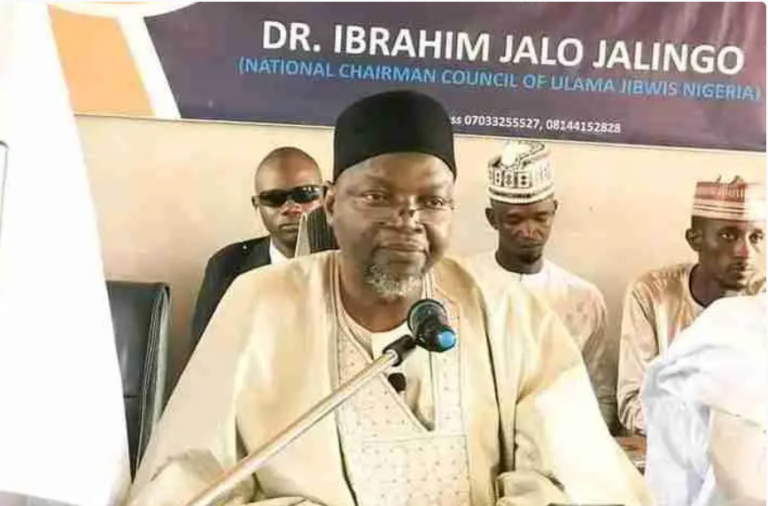
An Islamic cleric and the National Chairman of the Council of Ulama, Dr. Ibrahim Jalingo, has endorsed death penalty for religious faithful who renounce their religion.
In a strongly worded statement shared on his official Facebook page on Thursday, Jalingo openly defended a Hadith prescribing the death penalty for apostates and accused critics of Hadith literature of what he described as “compound ignorance.”
The cleric made the statement in response to criticisms questioning the authenticity of the Hadith, alleging that it contradicts the Quran.
A Hadith is a report of the sayings, actions, or approvals of the Prophet Muhammad (peace be upon him).
It serves as a key source of guidance in Islam, second only to the Qur’an.
In his post, Jalingo launched a detailed theological rebuttal against what he described as “fabricators” attempting to discredit the Hadith.
Jalingo, wrote: “Today, I came across the first Hadith among the supposed ‘100 Hadiths’ which the fabricators claim contradict the Qur’an. They assert that Muslims who believe in both the divine revelation of the Hadith and the Qur’an cannot respond to them! The Hadith in question is: ‘Whoever changes his religion, kill him.’ The person who presented this statement by the fabricators to me is someone named Issiyaku Abdulkadir.
“Here is what I wrote in response to the claims of these fabricators: First, I thank you for starting to bring me what this compound ignoramus refers to as ‘100 Hadiths that contradict the verses of the Qur’an.’ This will, God willing, give me the opportunity to expose his ignorance to the world”, Jalingo’s statement partly read.
Read Also:
Islamic cleric denies crime after butchering girlfriend
He continued by reinforcing the divine origin of Hadith, equating it with the Qur’an: “Second: It should be made clear to everyone that the Prophet (peace and blessings be upon him) never said: ‘The role of Hadith is to interpret the Qur’an.’ However, the Prophet said: ‘Indeed, I was given the Qur’an and something like it alongside it.’ What is true is that the Qur’an is a revelation from Allah, and so is the Hadith a revelation from Allah. Often, the Qur’an addresses a matter in a summarised or brief way, and then the revelation of Hadith comes to elaborate on that matter.”
In what is sure to spark fierce debates among scholars and human rights advocates, Jalingo defended the Hadith calling for the execution of apostates, citing Qur’anic verses in support: “Third: The Hadith you cited—’Whoever changes his religion, kill him’—is authentic and does not contradict the Qur’anic revelation. This is because Allah says in Surah At-Tawbah, verse 5: ‘Then, when the sacred months have passed, kill the polytheists wherever you find them.’
He supported his claims with another Quranic citation in Surah Al-Baqarah, verse 193, saying, “Fight them until there is no more fitnah (disbelief and oppression) and religion is for Allah alone.’ Meaning: fight them until they accept Islam.
And in Surah An-Nisa’, verse 89: ‘Kill them wherever you find them.’ And again in Surah An-Nisa’, verse 91: ‘Kill them wherever you confront them.’”
He further declared that the widely quoted verse advocating freedom of religion had been abrogated: “You see, unless someone is completely ignorant like the fabricators, no one would claim that the Hadith which says ‘Whoever changes his religion, kill him’ contradicts the Qur’an—because the Qur’an itself goes even further. It does not only permit the killing of apostates, but all polytheists in certain contexts.
“Fourth: You should also know that the verse ‘There is no compulsion in religion’ (La ikrah fi ad-deen) has had its ruling abrogated (naskh) by the verses we’ve just quoted, as well as by the very Hadith you brought: ‘Whoever changes his religion, kill him.’ And abrogation is a well-established concept within the revelation of the Glorious Qur’an.”
In a final explosive comment, Jalingo launched a personal attack on his critics, stating, “This is a brief response to the compounded ignorance of this individual—whose approach and manner resemble that of prostitutes and effeminate men—i.e., the so-called fabricators.”
The cleric’s post has since gone viral across social media, drawing both support and backlash.
While some hardline followers praised him for defending Islam, other Muslim voices have condemned the remarks as dangerous and inflammatory.

















https://t.me/s/Official_1win_kanal/761
https://t.me/site_official_1win/411
https://t.me/s/officials_pokerdom/3740
https://t.me/s/be_1win/665