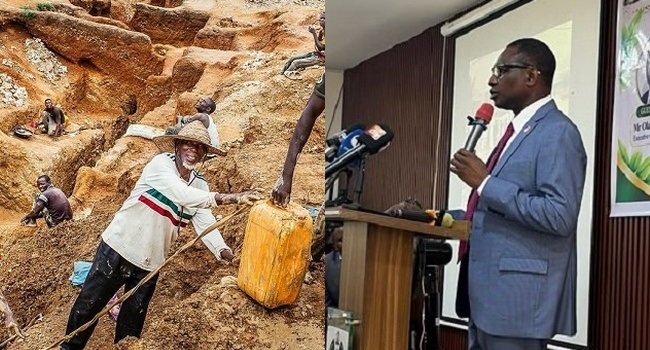
The Economic and Financial Crimes Commission (EFCC) has linked illegal mining in Nigeria to rising insecurity and organised crime, warning that it will intensify efforts to dismantle the financial networks behind the activities.
EFCC Chairman Ola Olukoyede said tackling illegal mining requires targeting financiers, mineral buyers, compromised public officials and other beneficiaries, rather than focusing solely on arrests at illegal mining sites.
He made the statement on Tuesday while delivering a keynote address at a public lecture and capacity-building workshop organised by the Michael Imoudu National Institute for Labour Studies in collaboration with the Human and Environmental Development Agenda in Ilorin, Kwara State.
According to the EFCC chairman, illegal mining creates opportunities for extortion, smuggling, violence and territorial disputes, while proceeds from stolen mineral resources could finance other criminal activities.
“There is a close connection between resource theft and insecurity. From an enforcement perspective, any economic activity that operates substantially outside regulation creates opportunities for criminal interests,” Olukoyede said.
EFCC Records 52 Illegal Mining Cases
Olukoyede disclosed that the commission recorded 52 illegal mining cases between October 2023 and July 2026, securing the forfeiture of 102 tonnes of solid minerals through its enforcement activities.
He said investigations had uncovered sophisticated criminal networks involving local and international players, with individuals responsible for financing mining operations, extracting minerals, arranging transportation, facilitating documentation and purchasing illegally obtained resources.
The EFCC chairman said the commission would follow financial transactions linked to illegal mining to identify those benefiting from the proceeds.
He emphasised that enforcement efforts must extend beyond mining sites to the individuals and organisations financing and profiting from the operations.
“Therefore, dealing with illegal mining involves breaking an impregnable chain of fraudulent actors: young men carrying shovels, their financiers, buyers of the minerals, compromised officials facilitating the operation, beneficiaries from the proceeds and other actors,” he said.
“A serious enforcement strategy must move from the pit to the purse,” Olukoyede added.
EFCC Clarifies Role in Mining Sector
The EFCC chairman clarified that the commission was not responsible for regulating the mining sector or issuing mining licences.
He explained that its involvement focused on suspected corruption, fraud, money laundering, illicit financial flows and the proceeds of criminal activities.
According to him, financial investigations are essential because proceeds from illegally extracted minerals eventually enter the financial system through payments, bank accounts, business transactions and asset acquisitions.
Olukoyede also warned that public officials who abuse their positions to facilitate illegal mining, manipulate licences or launder proceeds from mineral theft would face investigation.
EFCC Calls for Stronger Inter-Agency Cooperation
The commission called for stronger collaboration among mining regulators, financial intelligence institutions, law enforcement agencies, customs authorities and revenue agencies to improve intelligence sharing and coordinate investigations.
Olukoyede identified fragmented information among government institutions as a major challenge in tracking criminal networks.
He urged agencies to coordinate investigations across the mining value chain, covering licence ownership, mineral extraction, buyers, financial transactions and ultimate beneficiaries.
The EFCC chairman also called on host communities, traditional institutions, civil society organisations and local leaders to report suspicious mining activities.
He urged organised labour to demand lawful mining practices and decent working conditions.
Olukoyede reaffirmed the commission’s commitment to investigating financiers and facilitators, tracing illicit proceeds, recovering criminal assets and prosecuting suspects based on evidence.
He maintained that Nigeria’s mineral resources should contribute to national economic prosperity rather than enrich criminal networks.