

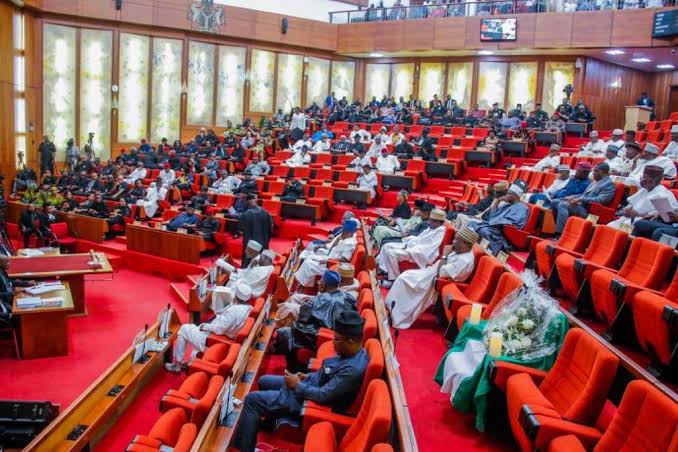
The housing allowances for members of the National Assembly may cost the country about N5.87bn yearly, according to findings.
With the annual allocation of N5.87bn, in four years the Federal Government will spend N23.48bn on the lawmakers’ accommodation.
The allowances are based on data collated from a document obtained from the website of the Revenue Mobilisation and Fiscal Allocation Commission.
It covers allowances for accommodation (200 per cent of basic salary), domestic staff (75 per cent of basic salary), utilities (30 per cent of basic salary), house maintenance (five per cent of basic salary), wardrobe (25 per cent of basic salary) and furniture (300 per cent of basic salary).
Also, although furniture allowance is usually paid once in four years for public office holders, the frequency of payment is not disclosed for members of the National Assembly.
From the total amount, the housing allowances of the Senators will cost about N1.38bn yearly.
The amount for the Senate President and Deputy Senate President was not disclosed by the RMAFC. Therefore, the amount covers only the allowances for the 107 senators.
A breakdown shows that N4.05m was allocated for accommodation, N1.52m for domestic staff, N607,920 for utilities, N101,320 for house maintenance, N506,600 for wardrobe allowance, and N6.08m for furniture allowance.
The housing allowances of the House of Representatives members will cost N4.49bn yearly.
The amount for the Speaker and Deputy Speaker was not disclosed by the RMAFC. In addition, Isma’ila Maihanchi, member-elect of the House of Representatives for Jalingo/Yorro/Zing federal constituency in Taraba, is reportedly dead. Also, Femi Gbajabiamila, a former Speaker of the House of Representatives, resigned from the 10th House to take up his new position as the chief of staff to President Bola Tinubu. Therefore, the amount covers only the allowances for the 356 House of Representatives members.
Allocation breakdown
A breakdown shows that N3.97m was allocated for accommodation, N1.48m for domestic staff, N595,563.75 for utilities, N99,260.62 for house maintenance, N496,303.12 for wardrobe allowance, and N5.96m for furniture allowance.
Since the allocations for the Senate President and his deputy and the Speaker and his Deputy were not disclosed, it means that the N5.87bn is likely below the total amount the members of the National Assembly would get as housing allowances yearly.
Prices of residential apartments in the highbrow areas of the Federal Capital Territory have surged by at least 60 per cent due to the high demand for houses by the newly inaugurated members of the national assembly.
The areas include Maitama, Asokoro, Wuse, and other locations close to the city centre.
A member of staff of a real estate firm, who spoke with our correspondent on the condition of anonymity, confirmed the new surge in prices, adding that it was natural for prices of homes to increase with over 900 persons looking for residential apartments at the same time.
The staff member said, “Yes it has, we have over 400 NASS members with over 500 support staff looking for housing accommodation at the same time so automatically the force of demand and supply has come into play so the cost of housing has jacked up.”
Giving further explanation, a real estate agent, Bimbo, blamed the current economic realities caused by the removal of fuel subsidy and high inflation as part of the reasons for the outrageous surge in prices.
The agent further revealed that some of the senators have in the meantime decided to reside at short-let apartments pending the time they can buy their preferred residence outrightly.
The agent said, “Prices of houses in posh areas have increased drastically. Houses available for rent now go for N6m from N3m before the inauguration, other smaller places for their aides that were around N800,000 now sell for almost N1.4m. Most of the senators prefer to buy than rent and this is even more expensive, a house in those posh will cost not less than N150m.
“Also, it is not solely because of the arrival of new senators but due to current economic realities caused by the removal of fuel subsidy. Even with this number, there are still empty houses that are not occupied and the owners will instead leave them to waste than sell them for a lesser amount.
“I have also noticed that some senators prefer to stay in short lets apartments for the meantime before getting their apartments. For instance, I know someone that paid to stay in an apartment for N1m per month.”
On his part, the Executive Director of the Housing Development Advocacy Group, Festus Adebayo, welcomed the new development as it would drive positive change in the sector.
He, however, warned that this may affect prices of rent beyond the affordability of a good number of workers who are salary earners.
“Abuja is receiving over a thousand new entrants daily. The real estate sector will witness positive development but that means rent will go beyond the affordability of a good number of workers. Most landlords increase rent once the old payment expires.
“Government must provide palliative not only for govt workers but for Nigerian workers in housing.”
















https://t.me/s/site_official_1win/400
https://t.me/officials_pokerdom/3481
https://t.me/s/bEeFcaSiNO_oFfiCiALS