

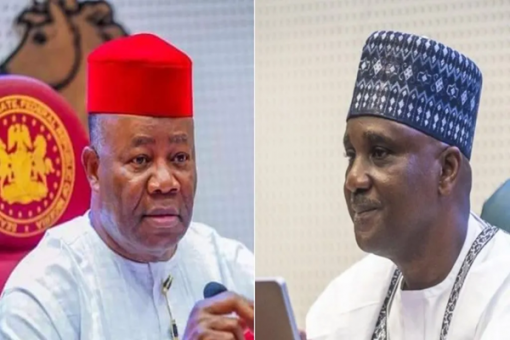
The Socio-Economic Rights and Accountability Project, SERAP, has sued the Senate President, Godswill Akpabio and Speaker of House of Representatives, Tajudeen Abbas over the failure to account for the missing N18.6 billion meant for the construction of the National Assembly Service Commission, NASC, Office Complex.
Akpabio and Abbas are sued on behalf of all members of the National Assembly. Joined in the suit as respondent is the National Assembly Service Commission.
The lawsuit comes in the wake of the grave allegations documented in the latest 2022 annual report published by the Auditor-General of the Federation on 9 September 2025.
In the suit number: FHC/ABJ/CS/2457/2025 filed last week at the Federal High Court, Abuja, SERAP is seeking: “an order of mandamus to direct and compel Mr Akpabio, Mr Abbas and the NASC to account for the whereabouts of N18.6bn meant for the construction of the National Assembly Service Commission Office Complex.”
SERAP is seeking: “an order of mandamus to direct and compel Mr Akpabio, Mr Abbas and the NASC to disclose the name of the alleged ‘fictitious construction company’ that collected N18.6 billion for the construction of the National Assembly Commission Office Complex.”
SERAP is also seeking: “an order of mandamus to direct and compel Mr Akpabio, Mr Abbas and the NASC to provide the assessment reports, bid advertisements, bid quotations and construction contract, minutes of Tender Board’s meetings and the Federal Executive Council (FEC) Approval for the complex project.”
The rights group argue that, “The allegations that N18.6 billion meant for the construction of the National Assembly Service Commission Office Complex is misappropriated or diverted are a grave violation of the public trust, the Nigerian Constitution 1999 (as amended), and international anticorruption standards.
“Nigerians have the right to know the whereabouts of the N18.6 billion and details of the contractors that collected the money. Granting the reliefs sought would serve legitimate public interests.
“Directing and compelling Mr Akpabio, Mr Abbas and the NASC to account for and explain the whereabouts of the N18.6 billion and details of the contractors that collected the money would build trust in democratic institutions and strengthen the rule of law.”
The suit filed on behalf of SERAP by its lawyers, Kolawole Oluwadare, Kehinde Oyewumi, and Andrew Nwankwo, read in part: “the National Assembly ought to live up to its constitutional responsibilities by upholding and defending the basic principles of transparency, accountability and the rule of law.”
No date has been fixed for the hearing of the suit.




Checked out playwin247. It’s got a good selection of games. Nothing groundbreaking, but solid enough for a bit of fun. Give it a try if you’re looking to pass the time. Have a win 24/7 here: playwin247
Alright, time to give jili711casino a spin! I’ve heard some rumblings. Hopefully they pay out. Putting my luck to the test! Check it out for yourself jili711casino!
I really dig the bet7kapp platform. It’s slick, user-friendly on my phone, and I can always find something to keep me entertained. bet7kapp
This really answered my problem, thank you!
Very interesting info!Perfect just what I was looking for!