


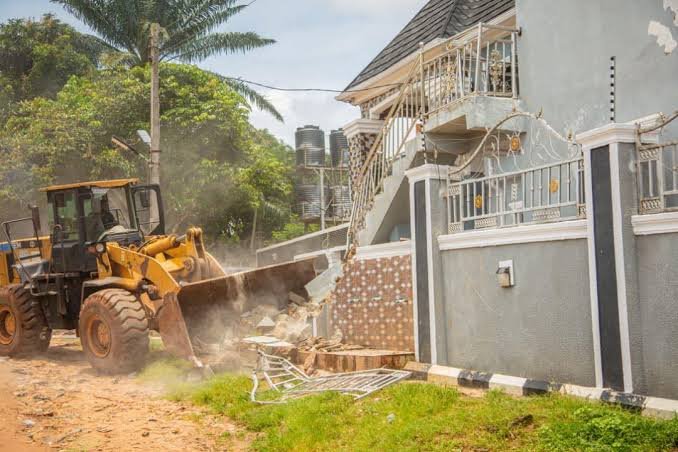
Anambra Governor Soludo has ordered the Onitsha market closure for one week following traders’ defiance of the government’s anti-sit-at-home directive
The governor gave the directive on Monday during an on-site visit to the market, along with some of his aides and other government officials.
Soludo warned that the closure could be extended if traders fail to comply with the directive, adding that security agencies have sealed the market to enforce the order.
The governor described the development as the latest—and perhaps most drastic—salvo in a protracted struggle over control of economic life in the South-East on Monday.
Soludo said that despite repeated assurances of enhanced security and appeals to reclaim public spaces, many traders at the iconic market once again chose to keep their stalls locked.
According to him, their absence amounted to a quiet rebellion that nonetheless spoke volumes about the lingering climate of fear.
Soludo said, “The government cannot stand by while a few individuals willfully undermine public safety and disregard official directives meant to restore normalcy. This is plain economic sabotage.
“We are not going to allow this. The closure is a protective measure for law-abiding citizens.”
He, however, issued a stern warning that if the market fails to reopen after the one-week shutdown, it will be sealed for one month.
“You either decide that you are going to trade here or you go elsewhere. I am very serious about this,” the governor added.
The scene at the market on Monday was marked by tense enforcement, as a joint task force comprising police, army, and other security agencies was seen securing the perimeter.
As the gates remain locked this week, the standoff in Onitsha highlights the broader struggle to abolish the Monday sit-at-home.
When the market is scheduled to reopen next Monday, attention will be on the traders—whether they will return to their stalls following the state’s show of force, or whether empty aisles will deliver a different verdict.
The outcome may determine not just the fate of the market, but the rhythm of economic life in Anambra State on Mondays.
The state government had earlier directed traders and businesses to continue normal activities on Mondays as part of efforts to restore economic stability and end disruptions caused by recurring sit-at-home observances.
Meanwhile, on Saturday the state government would begin pro-rata salary payments for workers across the state as part of efforts to end the Monday sit-at-home.
The state Commissioner for Information, Law Mefor, disclosed this to journalists in Awka, noting that effective February 2026, civil servants’ salaries would be paid according to attendance on Mondays.
Mefor said the decision was reached during the end-of-tenure retreat of the Anambra State Executive Council held in Awka, which reviewed the administration’s activities over its concluding four-year tenure and outlined priorities for the new term beginning on March 17, 2026.


















I have read some good stuff here. Certainly value bookmarking for revisiting. I surprise how a lot attempt you set to make this type of great informative website.
Spot on with this write-up, I actually think this website needs way more consideration. I’ll probably be once more to read rather more, thanks for that info.
Saved as a favorite, I really like your blog!
Amazing blog! Do you have any tips for aspiring writers? I’m hoping to start my own website soon but I’m a little lost on everything. Would you advise starting with a free platform like WordPress or go for a paid option? There are so many choices out there that I’m totally overwhelmed .. Any ideas? Cheers!
Hey, I’ve been checking out 1pra1 lately and it’s got some interesting stuff going on. Definitely worth a look if you’re bored. Check it out here: 1pra1
Just wanted to share my thoughts on 4winbetbr. For my Brazilian gambling friends, this place is seems cool for betting needs. Have a go: 4winbetbr
Anyone remember Friv? Well, I found fruv. Same idea, lots of little games. It’s a good way to kill a few minutes: fruv