
/ Oct 09, 2026
/ Oct 09, 2026

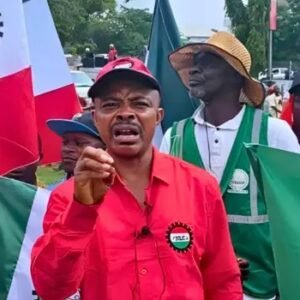
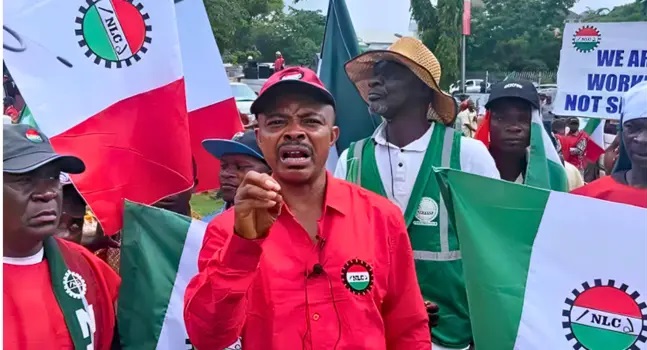
NLC’s Ajaero demands minimum wage increase as states pay more. 

Published on

By

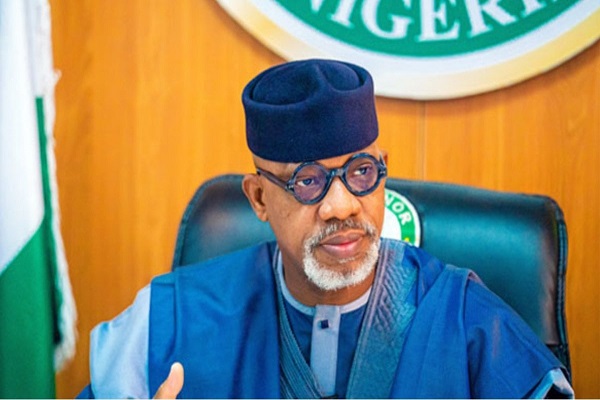
The President of the Nigeria Labour Congress (NLC), Joe Ajaero, has called on the Federal Government to review the ₦70,000 national minimum wage, citing higher wage payments by several state governments.


Ajaero said some states were paying workers more than the Federal Government, raising questions about the continued retention of the current federal minimum wage.

Speaking on Channels Television’s Sunrise Daily on Friday, October 9, 2026, the NLC president recalled that organised labour accepted the ₦70,000 minimum wage partly because President Bola Tinubu had raised concerns about the financial capacity of state governments.

According to Ajaero, Tinubu indicated during negotiations that the Federal Government could afford to pay ₦150,000 but urged labour to consider what state governments could afford.

He said negotiations between labour and the government had initially stalled at ₦60,000 before direct discussions with the President resulted in the ₦70,000 agreement.

“That was a negotiation between us and the president directly, not the minimum wage committee,” Ajaero said.

However, he argued that subsequent wage decisions by state governments had weakened the affordability concerns that influenced the negotiations.

Ajaero cited Imo State as paying ₦104,000, while other states were reportedly paying ₦100,000, ₦85,000, ₦84,000 and ₦75,000.

He maintained that the Federal Government should reconsider its position in light of the figures.

The NLC president said the lowest amount should be around ₦72,000 or higher, arguing that state governments were now paying more than the Federal Government.

The ₦70,000 national minimum wage became law on July 29, 2024, after President Tinubu signed the National Minimum Wage Act.

NLC Rejects 30-Day Fuel Discount as ‘Panicky Measure’

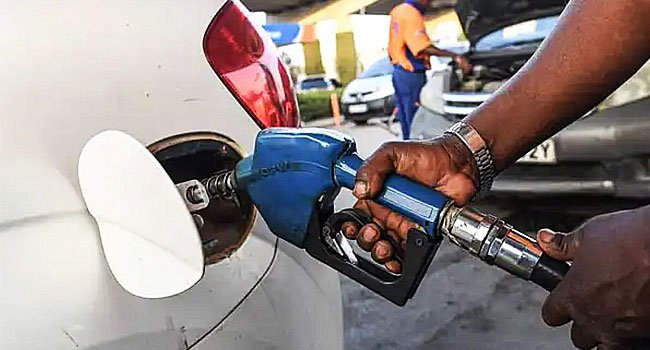
Ajaero also criticised the Federal Government’s 30-day petrol discount initiative, describing it as a “panicky measure” that had not changed organised labour’s demands.

He said the announcement had not altered the two-week ultimatum issued by the NLC over minimum wage negotiations, petrol pricing and measures to ease workers’ economic hardship.

The labour leader questioned how the proposed discount at Nigerian National Petroleum Company Limited outlets would affect prices charged by other fuel marketers.

He called on the government to clarify whether other marketers would offer similar discounts and explain what would happen after the 30-day period expired.

Ajaero noted that petrol sold for between ₦650 and ₦750 per litre when labour agreed to the ₦70,000 minimum wage, arguing that the government needed to explain how its latest intervention would address workers’ declining purchasing power.

NLC Lists Demands in Two-Week Ultimatum

Clarifying labour’s demands, Ajaero said the NLC was seeking renewed minimum wage negotiations, an interim wage award to cushion workers’ hardship and appropriate pricing for Premium Motor Spirit (PMS), commonly known as petrol.

He explained that the proposed wage award would serve as a temporary intervention while negotiations on the minimum wage continued.

The NLC president also called for tax relief, saying it was part of the agreement reached between organised labour and the Federal Government in 2023 but had yet to be implemented.

Ajaero further accused the government of failing to maintain meaningful dialogue with the NLC, alleging that labour’s letters had gone unanswered and discussions had been absent for two to three years.

His comments come amid renewed pressure from organised labour for the Federal Government to address rising living costs and improve workers’ purchasing power.
You May Like

Leave a Reply

Your email address will not be published. Required fields are marked *

Most Popular

Must Read

Nigeria’s growth hits 4.2% as state revenues surge 93% – World Bank

Nigeria’s economy grew by 4.2 per cent in the first half of 2026, while state government revenues surged by 93 per cent in real terms, creating opportunities for increased infrastructure investment, according to the World Bank.   The figures were contained in the bank’s latest Nigeria Development Update, titled Beyond the Federal Purse: How Higher Revenues Reshaped State Priorities, which examined the impact of rising public revenues on government spending and economic growth. The report, published on October 9, 2026, said economic growth improved from 3.9 per cent in the corresponding period of 2025 and 3.5 per cent in 2024. Services accounted for much of the expansion, supported by a stronger contribution from agriculture. The improvement also helped stabilise Nigeria’s poverty rate for the first time since 2019, although persistent inflation continued to weaken household purchasing power. State Revenues and Capital Spending Rise The World Bank reported that aggregate state revenues increased by approximately 93 per cent in real terms, while expenditure rose by about 92 per cent over the period under review. Between 2023 and 2025, gross federation revenues also increased by 69 per cent in real terms, largely reflecting exchange-rate reforms, the removal of the petrol subsidy and improvements in revenue administration. States recorded the largest increase in federation revenue flows, benefiting from higher statutory allocations, refunds, the settlement of outstanding federal obligations, dedicated intervention funds and stronger Value Added Tax collections. The additional funds supported increased capital spending, with capital expenditure rising from 46 per cent to 61 per cent of total state spending. Transport infrastructure recorded the largest increase, while housing, agriculture and other investments intended to support economic expansion also received higher allocations. However, the report noted that spending on education, healthcare and social protection grew more slowly than expenditure on economic infrastructure. Education Spending Falls Despite Higher Revenues Despite the increase in available public funds, education’s share of total expenditure declined from 14.9 per cent in 2021 to 12.1 per cent in 2025. Health spending remained broadly stable at around seven per cent of total expenditure, while social protection’s share increased from 1.4 per cent to 4.4 per cent over the same period. World Bank Country Director for Nigeria, Mathew Verghis, said the increase in state revenues presented an opportunity to improve essential public services and create jobs. “The bold macroeconomic reforms have substantially increased fiscal revenues at the state level, providing a unique opportunity to improve infrastructure, education, healthcare, and water services, which are critical to creating more and better jobs,” Verghis said. He added that stronger spending efficiency, accountability and service delivery would be necessary to ensure public resources translated into improved living conditions for Nigerians. Oil Prices Boost External Reserves The report also examined the mixed effects of the Middle East conflict on Nigeria’s economy. Higher oil prices strengthened export earnings, helping Nigeria’s current account surplus rise to $12 billion, equivalent to 7.1 per cent of gross domestic product, in the first half of 2026. This represented an increase from $8.6 billion, or 6.7 per cent of GDP, recorded in the corresponding period of the previous year. Although higher oil prices also boosted government revenues, existing commitments under forward oil sales and oil-backed financing arrangements limited the potential gains. Nigeria’s gross external reserves exceeded $54 billion in September 2026, supported largely by foreign portfolio inflows. The report also noted improvements in the functioning of the foreign exchange market following economic reforms. However, higher fuel prices following the outbreak of the conflict, combined with food price pressures during the lean season, slowed progress in reducing inflation. World Bank Projects 4.4% Growth Nigeria’s headline inflation declined from 27.6 per cent in January 2025 to 15.2 per cent in December 2025, supported by tight monetary policy and reduced exchange-rate volatility. The World Bank projected average economic growth of 4.4 per cent between 2026 and 2028, while inflation is expected to ease gradually to approximately 12 per cent by 2028. The bank also projected that poverty would begin to decline, although achieving sustained improvements in living standards would depend on the effective implementation of economic reforms. It stressed that improved internally generated revenue, stronger public spending efficiency and greater accountability at the state level would be essential to ensuring that increased government revenues translated into better public services and improved living conditions.
Read more

Editor's Pick

Trending News

Newsletter

Enter your email address and receive notifications of news by email.

You have been successfully Subscribed! Ops! Something went wrong, please try again.

© 2026 GongNews. All Rights Reserved.