
/ Oct 09, 2026
/ Oct 09, 2026

Anambra building collapse kills mother, 14-year-old daughter 

Published on

By

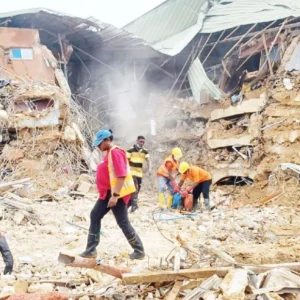
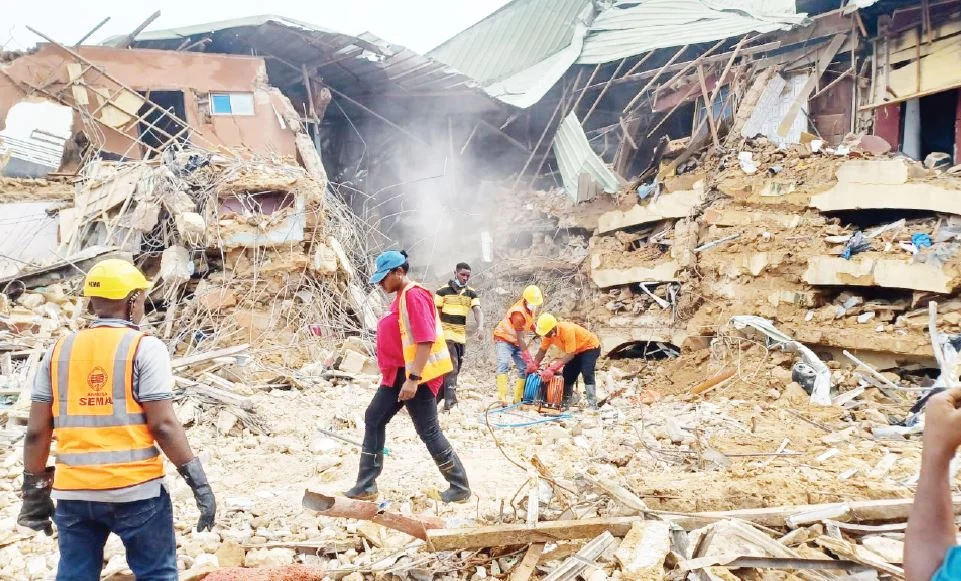
A mother and her 14-year-old daughter have died after a three-storey building under construction collapsed on their home in Okpoko, Ogbaru Local Government Area of Anambra State.


The victims, identified as Happiness Ugoagu and her daughter, Chikaima, were reportedly asleep in their bedroom when the incident occurred at about 9.45 pm on Thursday.

According to a report by Channels Television, the collapse happened in the Anata Anaba area of Okpoko, leaving the family devastated.

The woman’s son, Chimobi Ugoagu, said he was outside the house while his siblings were in the sitting room when the building collapsed.

He alleged that residents had previously warned the builder about the dangers posed by the structure, but their concerns were ignored.

Chimobi also claimed that an engineer had advised that the building should not exceed two storeys because the land was waterlogged.

Anambra Government Alleges Use of Substandard Materials

The Anambra State Commissioner for Physical Planning and Urban Development, Chijioke Ojukwu, visited the scene and described the incident as unfortunate.

Ojukwu alleged that substandard materials had been used in constructing the building.

He further disclosed that the authorities had previously issued a stop-work notice on the structure, which he described as illegal.

The commissioner ordered the demolition of the collapsed building’s remains and other unapproved buildings under construction in the area.

Ogbaru Council Chairman Calls for Investigation

The Chairman of Ogbaru Local Government Area, Nnamdi Ifejika, expressed sadness over the deaths and extended his condolences to the bereaved family.

He described the incident as a painful tragedy for the community, saying the loss of a mother and her daughter was heartbreaking.

Ifejika urged residents to report concerns about potentially unsafe buildings to the relevant authorities before they result in loss of life.

He also directed that the situation be closely monitored and called for an investigation into the circumstances surrounding the collapse.

The council chairman assured the bereaved family and the Okpoko community of the local government’s support. He further urged residents to cooperate with emergency personnel and relevant authorities.

The incident has renewed concerns about building safety, construction standards and compliance with development regulations.
You May Like

Leave a Reply

Your email address will not be published. Required fields are marked *

Most Popular

Must Read

Nigeria’s growth hits 4.2% as state revenues surge 93% – World Bank

Nigeria’s economy grew by 4.2 per cent in the first half of 2026, while state government revenues surged by 93 per cent in real terms, creating opportunities for increased infrastructure investment, according to the World Bank.   The figures were contained in the bank’s latest Nigeria Development Update, titled Beyond the Federal Purse: How Higher Revenues Reshaped State Priorities, which examined the impact of rising public revenues on government spending and economic growth. The report, published on October 9, 2026, said economic growth improved from 3.9 per cent in the corresponding period of 2025 and 3.5 per cent in 2024. Services accounted for much of the expansion, supported by a stronger contribution from agriculture. The improvement also helped stabilise Nigeria’s poverty rate for the first time since 2019, although persistent inflation continued to weaken household purchasing power. State Revenues and Capital Spending Rise The World Bank reported that aggregate state revenues increased by approximately 93 per cent in real terms, while expenditure rose by about 92 per cent over the period under review. Between 2023 and 2025, gross federation revenues also increased by 69 per cent in real terms, largely reflecting exchange-rate reforms, the removal of the petrol subsidy and improvements in revenue administration. States recorded the largest increase in federation revenue flows, benefiting from higher statutory allocations, refunds, the settlement of outstanding federal obligations, dedicated intervention funds and stronger Value Added Tax collections. The additional funds supported increased capital spending, with capital expenditure rising from 46 per cent to 61 per cent of total state spending. Transport infrastructure recorded the largest increase, while housing, agriculture and other investments intended to support economic expansion also received higher allocations. However, the report noted that spending on education, healthcare and social protection grew more slowly than expenditure on economic infrastructure. Education Spending Falls Despite Higher Revenues Despite the increase in available public funds, education’s share of total expenditure declined from 14.9 per cent in 2021 to 12.1 per cent in 2025. Health spending remained broadly stable at around seven per cent of total expenditure, while social protection’s share increased from 1.4 per cent to 4.4 per cent over the same period. World Bank Country Director for Nigeria, Mathew Verghis, said the increase in state revenues presented an opportunity to improve essential public services and create jobs. “The bold macroeconomic reforms have substantially increased fiscal revenues at the state level, providing a unique opportunity to improve infrastructure, education, healthcare, and water services, which are critical to creating more and better jobs,” Verghis said. He added that stronger spending efficiency, accountability and service delivery would be necessary to ensure public resources translated into improved living conditions for Nigerians. Oil Prices Boost External Reserves The report also examined the mixed effects of the Middle East conflict on Nigeria’s economy. Higher oil prices strengthened export earnings, helping Nigeria’s current account surplus rise to $12 billion, equivalent to 7.1 per cent of gross domestic product, in the first half of 2026. This represented an increase from $8.6 billion, or 6.7 per cent of GDP, recorded in the corresponding period of the previous year. Although higher oil prices also boosted government revenues, existing commitments under forward oil sales and oil-backed financing arrangements limited the potential gains. Nigeria’s gross external reserves exceeded $54 billion in September 2026, supported largely by foreign portfolio inflows. The report also noted improvements in the functioning of the foreign exchange market following economic reforms. However, higher fuel prices following the outbreak of the conflict, combined with food price pressures during the lean season, slowed progress in reducing inflation. World Bank Projects 4.4% Growth Nigeria’s headline inflation declined from 27.6 per cent in January 2025 to 15.2 per cent in December 2025, supported by tight monetary policy and reduced exchange-rate volatility. The World Bank projected average economic growth of 4.4 per cent between 2026 and 2028, while inflation is expected to ease gradually to approximately 12 per cent by 2028. The bank also projected that poverty would begin to decline, although achieving sustained improvements in living standards would depend on the effective implementation of economic reforms. It stressed that improved internally generated revenue, stronger public spending efficiency and greater accountability at the state level would be essential to ensuring that increased government revenues translated into better public services and improved living conditions.
Read more

Editor's Pick

Trending News

Newsletter

Enter your email address and receive notifications of news by email.

You have been successfully Subscribed! Ops! Something went wrong, please try again.

© 2026 GongNews. All Rights Reserved.