
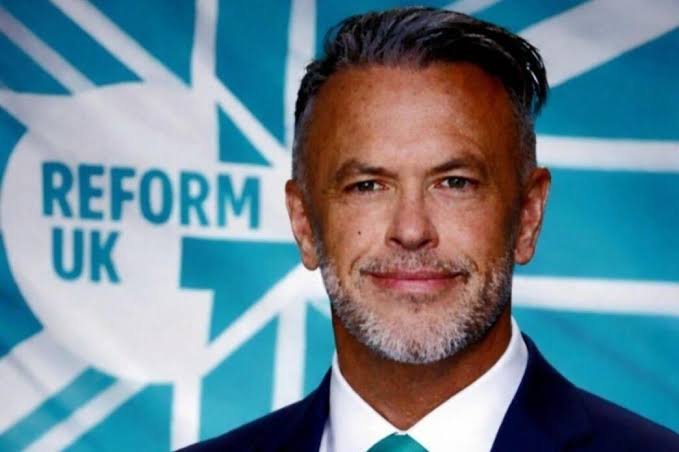
A 66-year-old United Kingdom councillor, Glenn Gibbins, has been convicted over a grossly offensive Facebook post in which he suggested that Nigerians living in Sunderland should be melted down and used to fill potholes.
Gibbins, a suspended Reform UK councillor, was found guilty following a three-hour trial at South Tyneside Magistrates’ Court.
According to a report by Chronicle Live, which was also published by PUNCH, District Judge Zoe Passfield sentenced him to a 12-month community order, including 150 hours of unpaid work.
The controversial Facebook post was made in March 2024, before Gibbins was elected to Sunderland City Council.
In the post, he wrote: “Can’t believe the amount of Nigerians in town… should melt them all down and fill in the potholes!!”
The remarks came to public attention after campaign group Hope Not Hate reviewed his social media activity when he was announced as a Reform UK candidate for the council.
Gibbins admitted that the comment was offensive but denied that it was grossly offensive, maintaining that it was intended as a joke rather than a literal threat.
During the trial, he described the post as “naughty” and “tongue-in-cheek”, insisting that nobody could reasonably interpret it literally.
He told the court that he had interacted with some Nigerians who approached his printing equipment business at the Bridges shopping centre in Sunderland.
According to his testimony, the encounter had been friendly, although he described the interaction as having “done my head in, in a funny way”.
He said he later saw a Facebook post about Nigerians after drinking a couple of cans of beer and attempted unsuccessfully to share it before typing his own message.
Asked about his intention, Gibbins told the court: “It was tongue-in-cheek, a bit naughty, but I thought it was fun.”
However, prosecuting counsel Emma Dowling argued that the statement was dehumanising and went beyond an offensive joke.
She told the court that the suggestion of melting Nigerians down conjured up despicable images and portrayed members of the community as less than human.
A Nigerian community leader in Sunderland, Godwin Ejeh, also testified about the impact of the comments.
Ejeh said he organised a protest outside City Hall on the day Gibbins was expected to be sworn in as a councillor, hoping to secure an apology.
However, Gibbins had already been suspended by Reform UK after the post emerged and did not attend the ceremony.
Ejeh, who contested the council election under the Liberal Democrats, denied using the controversy for political advantage.
“We are talking about humanity here; it’s way beyond politics,” he told the court.
Defence counsel Adam King described the Facebook post as “unfunny” and “an unpleasant joke/non-joke”.
He also cited examples of controversial jokes made by professional comedians, including Jo Brand and Jimmy Carr, arguing that such comments had not resulted in prosecutions.
Nevertheless, the court ruled that Gibbins’ remarks crossed the threshold of grossly offensive communication.
Reacting to the conviction, Christopher Atkinson of the Crown Prosecution Service in the North East said racially charged and grossly offensive comments could cross the boundary between freedom of expression and criminal behaviour.
He warned social media users that similar publications could attract criminal prosecution.
Gibbins’ conviction follows an investigation into his social media activity after his emergence as a Reform UK candidate.