
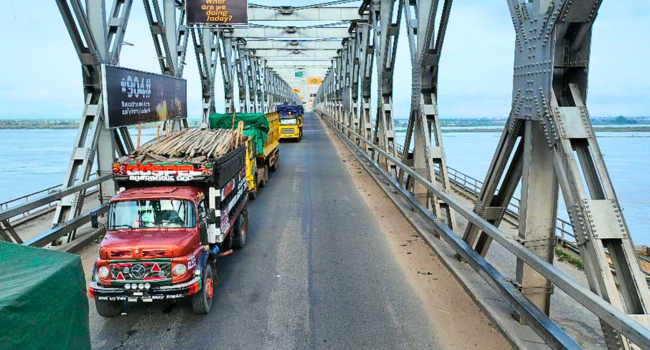
The Federal Government has reopened the First Niger Bridge to vehicular traffic following emergency maintenance and rehabilitation works aimed at improving its safety and extending its lifespan.
Minister of Works David Umahi announced the reopening at a ceremony in Asaba, Delta State, on Thursday, October 15, 2026, six weeks after the bridge was closed for repairs.
According to Channels Television, the rehabilitation became necessary following concerns about the bridge’s deteriorating condition, including missing bolts on its steel components, damaged sections and poor maintenance.
Umahi said the intervention included structural repairs, resurfacing, the installation of solar-powered streetlights and Closed Circuit Television (CCTV) cameras, as well as additional traffic safety measures.
The government also installed median barriers and provided three designated turnaround points to improve traffic management, particularly during emergencies and vehicle breakdowns.
The minister disclosed that security monitoring centres were being established at both ends of the bridge to strengthen surveillance and protect the infrastructure from activities that could compromise its structural integrity.
He also warned against excessive loading, traffic congestion and other practices that could threaten the durability of the ageing bridge.
FG Warns Against Sand Dredging Near Bridge
Umahi raised concerns about alleged sand dredging activities near the bridge, warning that federal regulations prohibit such operations within a 10-kilometre radius of federal bridges.
He directed relevant officials in Delta and Anambra states to enforce the restriction, adding that failure to do so could attract disciplinary action.
The minister also ordered a comprehensive redesign of the Benin-Asaba Expressway ahead of its reconstruction to address the road’s deteriorating condition.
He disclosed that the Federal Government had terminated the remedial contract for the first 11 kilometres of the highway over concerns about the quality of work.
Umahi expressed confidence that a fresh intervention would provide lasting relief to motorists who regularly use the busy route.
He further announced plans to reconstruct approximately 400 kilometres of the East-West Road, which he described as a spur of the 750-kilometre Lagos-Calabar Coastal Highway.
The minister reaffirmed the government’s commitment to major road projects across the Niger Delta and South-East, including sections of the Enugu-Onitsha Expressway and the Second Niger Bridge bypass.
Oborevwori, Asagba of Asaba Welcome Reopening
Delta State Governor Sheriff Oborevwori commended President Bola Tinubu for responding to concerns about the safety of the First Niger Bridge.
Represented by the Commissioner for Works (Rural Roads) and Public Information, Charles Aniagwu, the governor said the rehabilitation highlighted the importance of regular maintenance in preventing public infrastructure from deteriorating.
He noted that Umahi’s three visits to the bridge within two months demonstrated the Federal Government’s commitment to addressing concerns about its condition.
Oborevwori described the bridge as a critical economic link between the South-South and South-East, warning that any collapse would have severe consequences for businesses, trade and the movement of people across the regions.
Similarly, the Asagba of Asaba, Epiphany Azinge, SAN, described the rehabilitation as a major intervention that would strengthen the structure and extend its service life.
Speaking on behalf of the Asaba community, Azinge praised Tinubu and Umahi for ensuring the completion of the work.
He noted that the bridge remained central to economic and social connections between Delta and Anambra states, as well as the wider South-South and South-East regions.
Azinge described the exercise as potentially the second most extensive rehabilitation of the bridge since its construction shortly before the Nigerian Civil War.
He said the improvements would boost public confidence in the bridge’s safety and facilitate the movement of people and goods.
The traditional ruler also urged the Federal Government to accelerate other critical road projects, particularly the reconstruction of the Benin-Asaba Expressway.
Why the First Niger Bridge Was Closed
The First Niger Bridge was scheduled for closure from September 7 to 21, 2026, to allow the Federal Ministry of Works to carry out emergency maintenance and rehabilitation.
The exercise was intended to address the deteriorating condition of the bridge’s carriageway and damage to some of its components.
However, persistent rainfall disrupted the work and delayed the reopening beyond the initially announced period.
During the closure, motorists were advised to use the Second Niger Bridge through Obosi towards Asaba as an alternative route.
The reopening restores vehicular access across the First Niger Bridge, a major transport link connecting communities and supporting trade and economic activities between the South-South and South-East.