

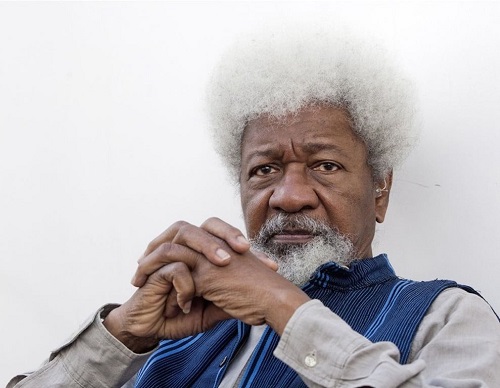
Nobel laureate Prof Wole Soyinka yesterday said Labour Party (LP) knew its candidate February 25 presidential poll did not win.
The literary giant accused the LP leadership of trying to force “a lie” on Nigerians, especially youths, that Obi won the election.
According to a report published by The Cable, he spoke at an event titled: “The Lives of Wole Soyinka — A Dialogue”. The programme organised by “Africa in the World” took place yesterday in Stellenbosch, South Africa.
Soyinka, who was asked to react to his comment against Datti Baba-Ahmed, Obi’s running mate, after the general election, said the truth matters to him. He noted that many people always look for shortcuts.
According to him, he was armed with facts when he invaded a radio station in Ibadan in 1965 and not “relying on “third-hand information” about the result of the regional election.
Accusing the LP of taking over the organised Labour movement in the build-up to the election, he noted that Obi achieved “something remarkable” by breaking the monopoly of power established by the All Progressives Congress (APC) and the Peoples Democratic Party (PDP).
He said: “This recent election – two things happened first of all. One party took over the Labour movement, which is not my favourite movement, and then it became a regional party.
“Whereas it was a marvellous breach into the established two camps. Peter Obi achieved something remarkable there, that he broke that mould. However, he did not win the election.
Read Also:
Peter Obi vows to pursue justice at Supreme Court
“I can say categorically that Peter Obi’s party came third not even second and the leadership knew it but they want to do what we call in Yoruba ‘gbajue’, that is force of lies.”
Soyinka also alleged that the LP leadership attempted to mobilise young people to protest against the outcome of the election on the “banner of lies and deceit”.
He said: “They were going to send some of the hardliners, proud young people into the street to demonstrate. I’m also ready to be among such demonstrators but only on the banner of truth not on lies, and deceit.”
Soyinka alleged that the LP wanted a post-election violence on the basis of a lie, adding that its vice presidential candidate went on television boasting, insisting, threatening and trying to intimidate both the judiciary and the rest.
He said: “What kind of government will result from that kind of conduct? In addition, they did not know this but they were being used.
“Before the election, there were certain clandestine forces, including some ex-generals, who were already calling for an interim government before the elections began.
“Some of them were known figures, including a proprietor of a university calling for an interim government before the election took place.”




















Nicely put. Appreciate it.
web site
Very well spoken genuinely! .
casino en ligne
Regards! Excellent information!
casino en ligne
Nicely put. Regards.
casino en ligne
Kudos. I like it!
casino en ligne
This is nicely put. .
casino en ligne
With thanks. Plenty of content.
casino en ligne
Position nicely utilized!!
casino en ligne
Amazing plenty of useful information!
casino en ligne
Truly quite a lot of very good information.
casino en ligne
https://t.me/site_official_1win/103
https://t.me/officials_pokerdom/3247
https://t.me/s/be_1win/327