
US President Donald Trump has threatened a fresh response against Iran after the two countries exchanged fire around the strategically important Strait of Hormuz.
Trump issued the warning on Monday following US strikes on Iran’s Larak Island on Sunday and subsequent Iranian missile and drone attacks targeting US military positions in the Middle East.
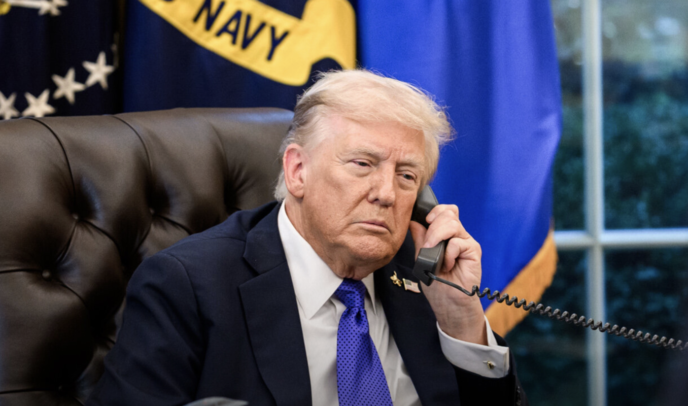
According to Channels Television, Trump said, “We’re going to hit them hard,” adding that there would be a response.
The latest escalation has raised fears of renewed major hostilities after weeks of relative calm in the six-month-old conflict.
Fighting Escalates Around Hormuz
The United States said its forces struck Iranian rocket launchers on Larak Island to prevent Iran from laying mines in the Strait of Hormuz, a crucial global shipping route.
Iran retaliated with missile and drone attacks that it said were aimed at US forces in Jordan and the United Arab Emirates.
Iran’s Revolutionary Guards claimed its ballistic missile attack on two US air bases in Jordan caused heavy damage. Trump, however, said nearly all missiles fired at US forces had been intercepted.
Jordan’s military said it intercepted eight missiles but did not identify their origin.
Iran also claimed to have targeted US personnel at an air base in the UAE and shot down an American drone over the Strait of Hormuz. Abu Dhabi confirmed that a drone had been intercepted over its waters but rejected claims that Al Minhad Air Base had been attacked.
The Revolutionary Guards later reported shooting down another US drone over Hormuz.
Tanker Hit Near Oman
The tensions also affected commercial shipping.
The UK Maritime Trade Operations agency said a tanker leaving the Strait of Hormuz was hit by three unidentified projectiles near Oman.
No casualties or environmental damage were reported.
Iran has maintained its blockade of the strategic waterway, while the US has continued its counter-blockade of Iranian ports.
Before the war, around one-fifth of the world’s oil passed through the Strait of Hormuz, making the confrontation a major concern for global energy markets.
US Steps Up Economic Pressure
Alongside military action, the Trump administration has intensified economic pressure on Tehran.
Trump described Iran as a “Failed Nation” on social media, claiming that its military had been severely weakened, its finances were deteriorating and its leadership was in disarray.
US Treasury Secretary Scott Bessent said Washington would continue applying economic pressure.
“We are going to continue exerting pressure,” Bessent told reporters at a G20 meeting in North Carolina, adding that a potential turning point could come within weeks or months.
Iran Calls For Dialogue
Despite the renewed military exchanges, Iranian President Masoud Pezeshkian called for negotiations.
Speaking at a summit in Kyrgyzstan, Pezeshkian said continuing the war was not in the interests of Iran or the wider region and called for dialogue and cooperation.
Iranian Foreign Minister Abbas Araghchi also urged the United States to return to its previous commitments, saying that doing so could put negotiations back on track.
Previous attempts by mediators to end the conflict have failed, with an earlier truce and memorandum of understanding collapsing.
For now, the Strait of Hormuz remains the central flashpoint between Washington and Tehran, with military confrontation and economic pressure continuing alongside diplomatic calls for a settlement.