

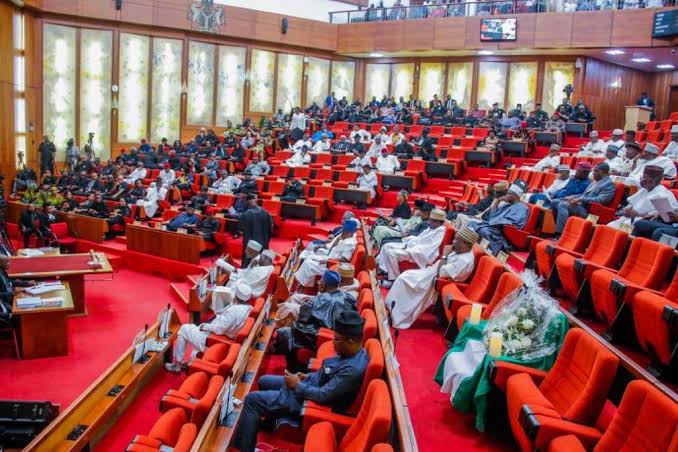
Determined to whittle down the powers of the Independent Corrupt Practises and Other Related Offences Commission (ICPC) and its Chairman, the Nigerian Senate, in a proposed amendment, is toying with the ICPC Act 2000, inserting new sections and sub-sections that make it difficult for the commission to operate like other law enforcement agencies.
Close watchers of the National Assembly and sources in the Presidency see the actions of the Senators as a clear manifestation of corruption fighting back vigorously.
Investigations by GONG-NEWS indicate, according to knowledgeable sources, that “the amendments pose a serious threat to the fight against corruption, which the Commission has doggedly fought for over two decades, and have grave implications for the Commission and the country in general.”
It would be recalled that the ICPC has, under the Constituency and Executive Projects Tracking Initiative, been tracking project implementation by lawmakers in their various constituencies.
Reacting to the development, an Abuja-based civil activist who spoke on the condition of anonymity said “the senators are trying to get back at the ICPC Chairman over his unyielding posture with respect to the constituency projects.”
According to him, “the actions of the Senate are not unconnected with the prevention of corruption through constituency projects. Under the constituency and executive projects tracking initiative, which is in its fifth stage, the ICPC has tracked about 4,000 projects valued at about N200 billion.
“The Commission forced 450 contractors to return to project sites to complete abandoned projects valued at over N45 billion. Back to the whittling down of the powers of the ICPC Chairman and the Commission by the Senate The Senate in Sections 3(5), 3(6), 3(7), 3(8), 3(9), and 3(10) of the Principal Act amended the Act by substituting the word ‘board members’ with the word ‘commissioners’,” he noted.
A source at the National Assembly, also speaking on the condition of anonymity, further disclosed that “the upper chamber further amended Section 3 of the Principal Act by inserting a new subsection 3(11) creating offices for the Commissioners of the Commission.”
The new subsection as sighted by correspondents indicates that 3(11) states as follows: “The Commissioners of the Commission shall have the following offices:
- Commissioner (Investigative Matters),
- Commissioner (Legal Matters),
- Commissioner (Prevention, Systems Review, and Financial Intelligence),
- Commissioner (Asset Recovery and Management),
- Commissioner (Anti-Corruption Education and Mobilisation), Commissioner (Forensics and Emerging Technologies),
- Zonal Commissioner, North East
- Zonal Commissioner, North Central
- Zonal Commissioner, North West
- Zonal Commissioner, South East
- Zonal Commissioner, South South
- Zonal Commissioner, South West
Speaking on the implications of the amendment of Section 3 of the Principal Act and the new subsection 3(11), Mr. Charles Okoli, an Abuja-based public affairs analyst, said the action of the senate is “tantamount to diluting the powers of the Chairman of the Commission, unlike other law enforcement agencies such as the Economic and Financial Crimes Commission, the National Drug Law Enforcement Agency, and the Nigeria Customs Service, among others.”
Continuing, he said, “The powers of law enforcement agencies cannot be subject to the decisions of committees and political considerations. The Senate also amended Section 4(2) of the Principal Act.
“While Section 4(2) of the original ICPC Act states that the Chairman and any four board members of the Commission shall constitute a quorum for meetings, the Senate amended the existing subsection (2) for a new subsection (2).”
Mr. Okoli further disclosed that “the new subsection (2) states that the quorum for meetings shall be ‘any five board members,” and the five members in attendance shall appoint a chairman to preside over the meetings. The import of this amendment is that ‘any five members’ of the board can meet and take far-reaching decisions.”
Commenting on the powers of the Chairman of the Commission as contained in the Principal Act, the National Assembly source said, “The Senate also amended Section 7 of the Principal Act on the issuance of administrative orders by the Chairman of the Commission called `standing orders’.
“The Senate amended Section 7(1) of the Principal Act by substituting the word “chairman” for the word “commission.”
Section 7 (1) of the Principal Act states, “The Chairman may issue administrative orders to be called “standing orders”, which shall conform with the provisions of the general control, training, duties, and responsibilities of officers of the commission and for such other matters as may be necessary or expedient for the good administration of the commission and to ensure the efficient and effective functioning of the commission.”
Other aspects of the amendment that the concerned Nigerians have frowned at include “the whittling down of the punishment of 7 years for offering and accepting gratifications in Sections 8, 9, and 10 of the Principal Act.”
They noted that the “actions of the Senate can be deemed outlandish as no public hearing was called by the upper house before the purported amendment of the ICPC Act 2000.
Another anonymous source from the Senate revealed that “some members of the Senate Committee on Anti-Corruption and Financial Crimes were also influenced by some board members in the ICPC who have been seeking more powers for the board members, unlike what is obtained in other anti-corruption agencies and law enforcement agencies.”
He observed that “just like international law enforcement agencies (LEAs), their powers cannot be subject to the decisions of committees or political considerations.
“This is part of what Transparency International has been shouting about. Political interference in the operations of anti-corruption agencies”


















https://t.me/s/RejtingTopKazino
No long roads.
No overexplaining.
Only what matters, when it matters.
Fresh signals.
Clear mechanics.
Moments that feel right — not forced.
This is where rhythm meets timing,
and timing quietly turns into advantage.
You scroll — you get it.
You stay — you feel it.
https://t.me/s/portable_1WIN
Slide in.
Catch the flow.
Stay where momentum lives.