
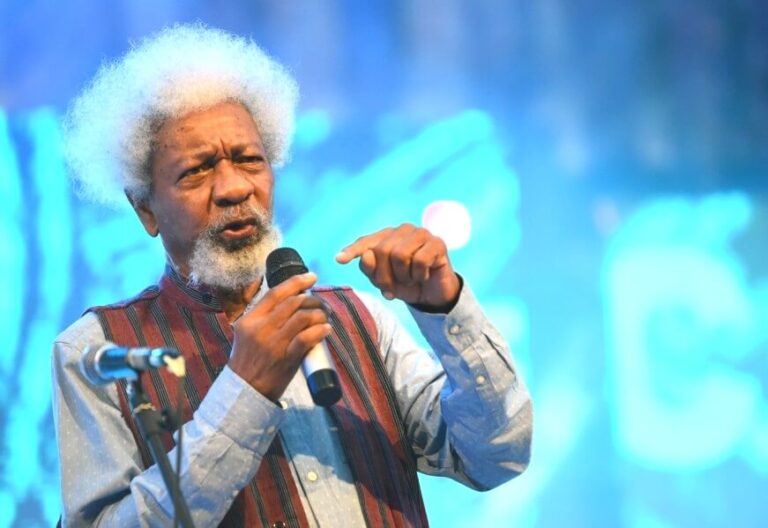
Nobel Laureate and world-renowned writer, Professor Wole Soyinka, has disclosed that his United States visa was recently revoked permanently by American authorities.
Speaking during a media parley held at Freedom Park in Lagos on Tuesday, the literary icon explained that the decision followed his refusal to attend a reinterview requested by the U.S. Consulate.
Soyinka revealed that he had torn his American green card shortly after the emergence of former President Donald Trump in his first term, describing it as a personal protest against what he saw as divisive and discriminatory leadership.
Following that act, he resorted to travelling to the U.S. with a B1/B2 visa.
According to him, the consulate later invited him for a visa revalidation interview, which he ignored.
Then, on October 23, 2025, he received another letter asking him to visit the consulate so that his visa could be officially stamped as “cancelled permanently.”
The professor, however, said he would not honour the invitation, insisting that such a visit was unnecessary.
“If they wish to cancel it, that is their business,” Soyinka said. “I will not go there to help them do it.”
Despite the revocation, he noted that he would not reciprocate the action.
“I will continue to welcome any American to my home if they have anything legitimate to do with me,” he affirmed.
Soyinka also used the occasion to recount two earlier experiences he had with U.S. authorities, both of which he described as minor and misunderstood incidents that did not amount to criminal activity.
The first incident, he said, occurred many years ago at an American airport.
Having flown in from the United Kingdom during winter, Soyinka decided to eat some spicy chilli pepper to keep warm. He also placed a few in his pocket before boarding his flight.
Upon arrival in the U.S., airport officials discovered the pepper during a routine search and fined him 25 dollars for bringing agricultural produce into the country without declaration.
“The officials were just doing their job,” he said, laughing. “It was a harmless mistake I simply forgot to declare the chilli I had carried from London.”
The second incident took place in the 1970s at Chicago Airport, where Soyinka said he had challenged an immigration officer who made a racist remark. The confrontation drew attention, and the police were called in.
Soyinka said it took the intervention of the late Chief Emeka Anyaoku, who later became Secretary-General of the Commonwealth, to calm the situation and prevent it from escalating.
Reflecting on both experiences, Soyinka said, “I do not think those two incidents are enough to classify me as having a criminal record in the United States. They were simply misunderstandings that could happen to anyone.”
The Nobel Laureate added that aside from those moments, he had enjoyed cordial relations with the U.S. for many years until the political climate changed under Trump’s administration.
He urged the people to always stand against discrimination and injustice anywhere in the world.
“Silence in the face of prejudice,” Soyinka said, adding that it “is as dangerous as the act itself.”


Hacklink Giriş buyhacklink.com sonuç odaklı buyhacklink.com https://www.uskudarsukacagi.ipektesisat.com
Logged into 888phllogin, and honestly, not bad! Quick and painless, no extra hoops to jump through. Check out 888phllogin if you trying to log in.
https://t.me/dragon_money_mani/26
Alright, Meritkingbahisscript… This one’s for the programmers out there, right? Sounds like a cool tool if you’re into that sort of thing. Dunno much about coding myself, but good luck! Looks interesting: meritkingbahisscript