
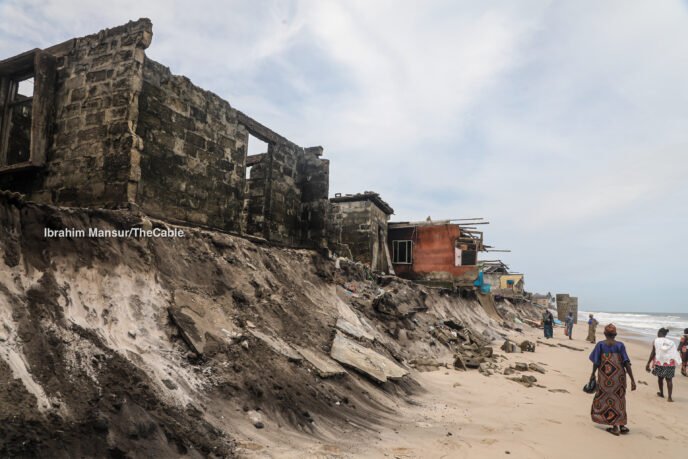
Residents of Okun-Ajah, a coastal settlement in Lagos State, are grappling with the devastating impact of coastal erosion that has destroyed homes, businesses, graves and public infrastructure, leaving many families displaced and struggling to rebuild their lives.
According to a report by TheCable, the Atlantic Ocean has steadily encroached on the community since March, washing away residential buildings and critical community assets along the Lekki-Epe coastline.
Among those affected is 34-year-old Oluwanifemi Olanrewaju, whose ancestral home was swallowed by the ocean. The widow said the property was the only inheritance left to her by her late mother.
The disaster also exposed and washed away the grave of her grandfather, forcing neighbours to recover and rebury his remains elsewhere.
Olanrewaju, who is raising her teenage son and caring for her elderly father, said she now depends on temporary accommodation provided by friends and church members after losing her home.
Mosque destroyed as residents lose place of worship
The community’s central mosque has also been severely damaged by advancing ocean waters.
Abdulmalik Majid, a caretaker of the mosque, said coastal erosion first destroyed the ablution area and a nearby well before eventually overwhelming the structure.
As a result, many worshippers now travel up to two kilometres to attend prayers in neighbouring communities, while others pray at home due to safety concerns.
Residents were seen removing roofing sheets and other materials from the damaged mosque in an effort to salvage what remained before further collapse.
Widows and families bear the brunt
Another resident, Khadijah Alimi, said she lost her late husband’s only property to the ocean.
Already coping with the death of her husband and one of her twin daughters in recent years, Alimi said the latest disaster wiped out nearly all her belongings, leaving her and her grandchild without permanent shelter.
She now relies on temporary accommodation provided by another family while seeking support to rebuild her life.
Economic activities disrupted
The impact extends beyond residential areas.
Kids Beach Garden, a popular beachfront recreation centre and a major source of income for women in the community, has suffered significant damage from the advancing waves.
Founder Doyinsola Ogunye said many workers and small business owners have lost their means of livelihood as sections of the beachfront disappeared beneath the sea.
She noted that recurring erosion and flooding have become an annual challenge but described this year’s destruction as particularly severe.
Ogunye also highlighted the emotional toll on residents forced to exhume and rebury relatives after graves were exposed by erosion.
Climate change and human activity blamed
Experts say the crisis is being driven by a combination of climate change and human activities.
Gloria Okafor, a senior lecturer in meteorology and climate change at the Nigeria Maritime University, said Lagos remains highly vulnerable because of its low elevation and exposure to coastal processes.
She warned that rising sea levels, storm surges, rapid urbanisation and activities such as dredging are increasing the risk of erosion along the coastline.
Okafor added that forecasts suggesting the possible emergence of another strong El Niño event between May and July 2026 could worsen coastal hazards, flooding and shoreline degradation.
She called for urgent investments in coastal protection infrastructure, ecosystem restoration, early warning systems and community resilience programmes.
Lagos government promises action
Responding to concerns, Lagos State Commissioner for Waterfront Infrastructure Development, Ekundayo Alebiosu, said the state government is collaborating with international experts, including consultants from the Netherlands, to develop evidence-based solutions.
Alebiosu noted that coastal erosion affects several communities across West Africa and stressed that interventions must be guided by scientific studies to avoid unintended consequences.
He said meaningful coastal protection projects would require collaboration between the state government, federal authorities and international partners.
The report, published on World Environment Day, highlights the growing threat coastal erosion poses to vulnerable waterfront communities and the urgent need for climate adaptation measures across Lagos and other coastal regions.