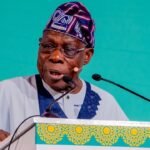
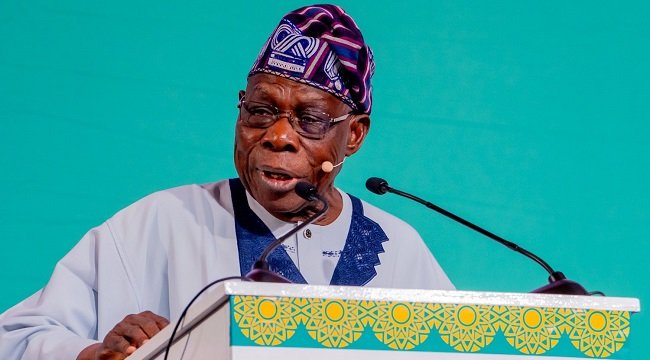
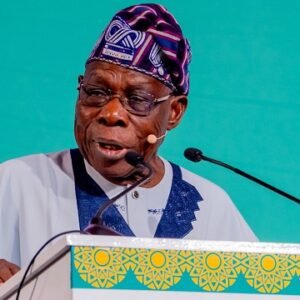
Former President Olusegun Obasanjo has criticised President Bola Tinubu’s economic reforms, accusing his administration of worsening poverty in Nigeria through the devaluation of the naira. Obasanjo made the remarks on Wednesday at the Financial Times Africa Summit 2026 in London, United Kingdom, where he argued that the sharp decline in the naira’s value had significantly weakened Nigerians’ purchasing power. According to a report by The PUNCH, the former president said the naira’s depreciation had effectively made Nigerians 300 per cent poorer. “We do not live in isolation as a country. We interact with the rest of the world. And overnight, you devalue the currency by 300 per cent. The naira went from N500 to a dollar to N1,500 to a dollar. What that meant was that every Nigerian is made poor by 300 per cent,” Obasanjo said. He described Nigeria as the “poverty capital of the world”, arguing that the country had the largest number of people living in poverty. “You cannot say to me that that is good for Nigeria. You cannot say to me that that is good for us in any sense,” he added. Obasanjo Questions Economic Recovery The former president also rejected arguments that Tinubu should be given more time to deliver the benefits of his economic reforms. Obasanjo said he had yet to see sufficient improvement in the economy to justify the hardship experienced by Nigerians. “For the economy, I don’t see anything getting better. What policies are you seeing through? You impoverish your people, and you want to see impoverishment through?” he asked. He further argued that the policies introduced by the Tinubu administration were not in the best interests of Nigerians. “Nobody can deny that,” he said. Former President Questions Fuel Subsidy Removal Obasanjo also criticised the handling of petrol subsidy reform, noting that fuel costs affected virtually every aspect of economic activity. While acknowledging the importance of addressing the subsidy issue, he argued that corruption associated with the system should have been tackled first. He maintained that a country facing severe economic difficulties should focus on reducing corruption, waste and unnecessary luxury while increasing production. Naira Depreciation and Inflation The Central Bank of Nigeria unified the country’s foreign exchange market windows on June 14, 2023, during the early days of Tinubu’s administration. Before the policy, the official exchange rate stood at approximately ₦460.80 to the dollar. By October 19, the official rate had weakened to about ₦1,333.54 per dollar, according to figures cited by The PUNCH. The naira also fell to approximately ₦1,607.05 per dollar in early May 2025. Despite the currency’s depreciation, official figures indicated that some economic indicators had improved. The National Bureau of Statistics reported that headline inflation fell to 14.63 per cent in September 2026, compared with 20.98 per cent a year earlier. However, food inflation remained high at 19.59 per cent, while Nigeria’s real gross domestic product grew by 4.43 per cent in the second quarter of 2026. The figures highlight the continuing economic pressures facing households, particularly the cost of food and other essential goods. FG Defends Savings From Subsidy Removal Meanwhile, the Minister of Finance and Coordinating Minister of the Economy, Taiwo Oyedele, said on August 19 that the removal of petrol subsidies had saved the Federal Government ₦15.8 trillion between June 2023 and December 2025. The savings form part of the government’s justification for ending the subsidy regime, a policy that has significantly altered petrol pricing and public finances. Efforts by The PUNCH to obtain a response from the Presidency to Obasanjo’s remarks were unsuccessful. The newspaper reported that the President’s Special Adviser on Information and Strategy, Bayo Onanuga, could not be reached.
Read more